Monday
Monday: Measure the Pole by Its Shadow
Comet stands at the foot of the tall pole outside the loading door. "The rigging line goes to the top. How tall is it?"
"No ladder reaches," Wren says. He plants a meter stick upright in the gravel. "What do you notice about the two shadows?"
"Both point the same way. The stick is one meter and its shadow is 0.8. The pole's shadow is 3.2."
Nova projects two triangles on the ground, a small one at the stick and a big one at the pole.
"Would you like a hint? Both have a right angle at the ground, and the light makes the same angle at both tips."
"Two equal angles. AA. The triangles are similar," Comet says. "So the pole is 3.2 divided by 0.8, times one meter."
"Four meters," Wren says. "Our designer, check our work and then find the door frame."
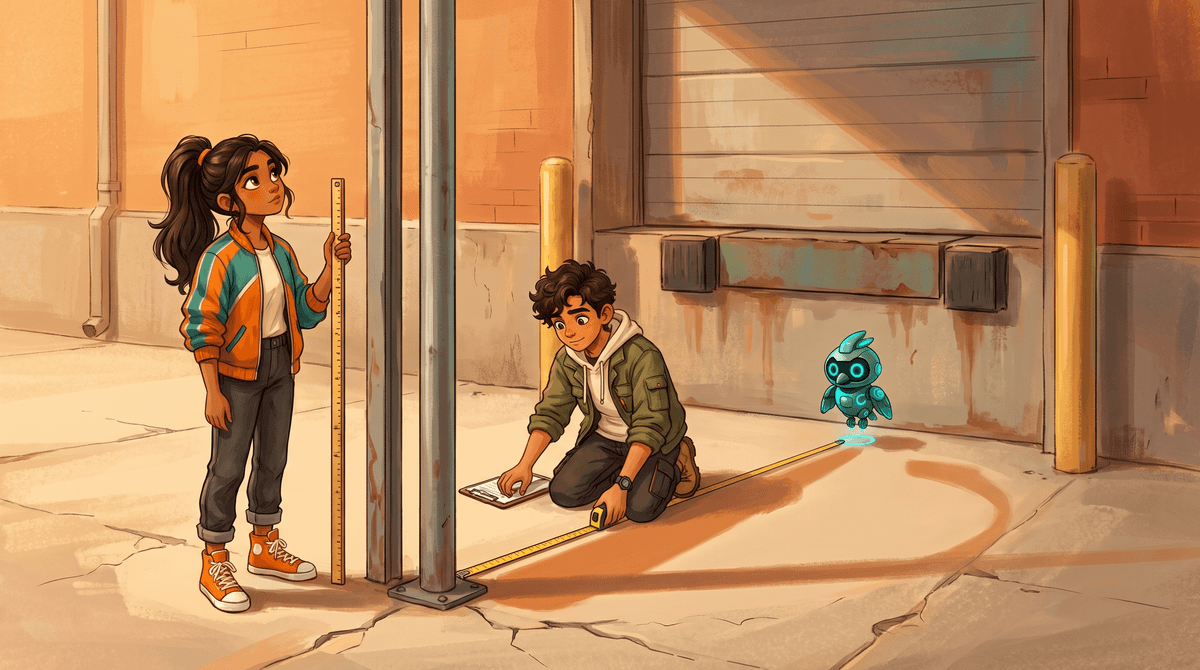
Two shadow triangles
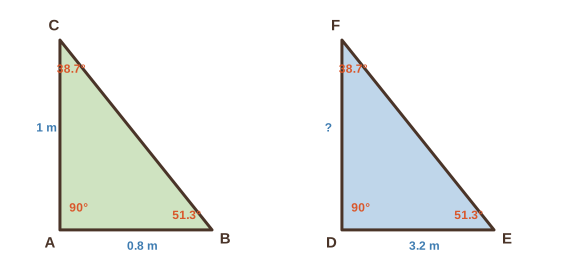
Each upright object and its shadow make a right triangle with the ground. The slanted side runs from the shadow tip to the top.
The crew measured the angle at both shadow tips: about 51.3° each time. With the right angles, that is two equal angles: AA.
Similar triangles have proportional corresponding sides. The stick is to its shadow as the pole is to its shadow.
A solved problem to study
Wren's work: the ratio of shadows is 3.2 ÷ 0.8 = 4. That is the scale factor from the small triangle to the big one.
The pole is the stick times the same factor: 1 × 4 = 4 meters.
Why does it work? The two triangles are similar by AA, so every pair of corresponding sides has the same ratio.
The shadows are one pair, the heights are another. Same ratio, so one division and one multiplication finish it.
| Object | Shadow (m) | Height (m) |
|---|---|---|
| meter stick | 0.8 | 1 |
| pole | 3.2 | 4 |
| loading door frame | 1.6 | 2 |
- Read the question.
- Tap your answer.
- Read the question.
- Tap your answer.
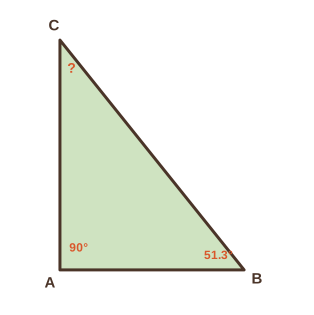 A shadow triangle has a right angle and a 51.3° angle at the shadow tip. What is the angle at the top?
| Statement | True or false? |
|---|---|
| The two shadow triangles are similar because of two equal angles. | ? |
| A taller object casts a shorter shadow at the same moment. | ? |
| 3.2 ÷ 0.8 = 4 ÷ 1 | ? |
| The shadow method needs someone to climb the pole. | ? |
| Corresponding sides of similar triangles are in the same ratio. | ? |
Work out the post's height. Never look at the Sun while you measure.
Strong start, designer. Tomorrow a cross piece splits a brace in two, and you prove the split is in proportion.