Monday
Monday: Shrink the Whole Set
Comet sets a shoebox-sized cardboard flat beside the full-size one. "The scale model. Everything one tenth."
Wren holds the model up at arm's length and squints past it at the real flat. "Same shape. What do you notice?"
"It is the same flat, just small. Every length is divided by ten. The angles did not change."
Nova hovers over the chalk grid and projects a small triangle, then a big copy with rays fanning from one corner.
"Would you like a hint? Every point slid out along its ray, twice as far from the center."
"That is a dilation," Wren says. "Center, scale factor, done. Last week was slides, flips and turns. This is the fourth move."
"The move that changes size," Comet says. "Our designer, help us pin down exactly what it does."

What a dilation is
A dilation needs a center O and a scale factor k. It sends each point P to a point P′ on the ray from O through P.
The distance OP′ is k times the distance OP. The center itself does not move.
A factor bigger than 1 enlarges. A factor between 0 and 1 shrinks. A factor of 1 changes nothing.
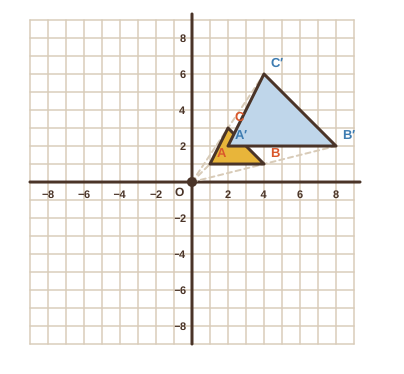
A solved problem to study
Wren dilates the cardboard triangle (1, 1), (4, 1), (2, 3) from the origin with scale factor 2. Here is his work.
Every coordinate is multiplied by 2, because the center is the origin: A (1, 1) goes to A′ (2, 2).
B (4, 1) goes to B′ (8, 2), and C (2, 3) goes to C′ (4, 6).
Check one length: AB is 3 units and A′B′ is 6 units, exactly 2 times as long.
Why does it work? A point at (x, y) is x across and y up from the origin. Doubling its distance along the ray doubles both.
When the center is not the origin, measure from the center instead. From C (1, 1), the point (3, 2) is 2 across and 1 up.
Scale factor 3 makes that 6 across and 3 up, so the image is (7, 4).
- Read the question.
- Tap your answer.
- Read the question.
- Tap your answer.
| Statement | True or false? |
|---|---|
| The center of a dilation does not move. | ? |
| A scale factor of 1/10 makes a figure larger. | ? |
| 3 × 2 = 6 | ? |
| A dilation moves every point along a ray from the center. | ? |
| A dilation is one of the three rigid motions. | ? |
Double each corner's distance along its ray and join the new corners. Measure one old side and its new side.
Strong start, designer. Tomorrow you test what a dilation does to lines and lengths, and prove it.