Thursday
Thursday: Proof Day, the Parallelogram Frame
Wren stretches two strings across the frame, corner to corner. "The diagonals. Comet, where do they cross?"
Comet measures from each corner to the crossing. "Each string is split in half. Both of them."
"Coincidence?" Wren asks. "Or a theorem? What does the evidence say?"
"Every frame we built this way did it," Comet says. "But you said measuring is not proving."
Nova projects the frame with one diagonal drawn. Two triangles glow, one above the string, one below.
"Would you like a hint? The frame's sides are parallel, and a diagonal is a transversal."
"Alternate interior angles," Comet says slowly. "Two pairs. And the diagonal is shared. That is ASA!"
Wren nods. "Our designer, write it up. Then the diagonals."
The frame on the sawhorses
A parallelogram is a four-sided figure whose opposite sides are parallel. The crew's frame: AB and CD parallel, BC and DA parallel.
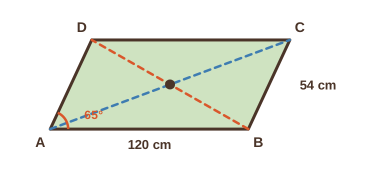
The crew's own tape-measure readings for the frame, in centimeters and degrees. M is where the diagonals cross.
| Part | Reading | Part | Reading |
|---|---|---|---|
| AB | 120 cm | CD | 120 cm |
| BC | 90 cm | DA | 90 cm |
| Angle A | 65° | Angle C | 65° |
| Angle B | 115° | Angle D | 115° |
| Diagonal AC | 177.8 cm | AM and MC | 88.9 cm each |
| Diagonal BD | 115.6 cm | BM and MD | 57.8 cm each |
Proof 1: opposite sides and angles are congruent
- Given: parallelogram ABCD. Draw diagonal AC.
- AB is parallel to CD and AC is a transversal, so angle BAC = angle DCA (alternate interior angles).
- BC is parallel to DA and AC is a transversal, so angle BCA = angle DAC (alternate interior angles).
- AC is a side of both triangles ABC and CDA, so AC = AC.
- Triangle ABC is congruent to triangle CDA by ASA.
- So AB = CD, BC = DA and angle B = angle D. Drawing BD the same way gives angle A = angle C.
Proof 2: the diagonals bisect each other
- Given: parallelogram ABCD with diagonals AC and BD crossing at M.
- AB = CD, by Proof 1.
- Angle BAM = angle DCM and angle ABM = angle CDM (alternate interior angles across each diagonal).
- Triangle ABM is congruent to triangle CDM by ASA.
- So AM = CM and BM = DM. Each diagonal is cut in half at M.
Consecutive angles, like A and B, lie along a transversal between parallel sides, so they add to 180°.
Rectangles are the parallelograms whose diagonals are congruent. In a rectangle every angle is 90°, so triangles ABC and DCB match by SAS. Then AC = BD.
- ?Given: parallelogram ABCD, with diagonal AC drawn
- ?Angle BAC = angle DCA, alternate interior angles across AB and CD
- ?Triangle ABC is congruent to triangle CDA by ASA
- ?So AB = CD and BC = DA
- ?Angle BCA = angle DAC, alternate interior angles across BC and DA
- ?AC = AC, the shared side
- Read the question.
- Tap your answer.
Angle A of the frame is 65°. What is angle C?Angle A of the frame is 65°. What is angle B, next to it?Proved, designer. The frame earned its name. Tomorrow you find these theorems around the house and review the week.