Tuesday
Tuesday: Roots Undo Powers
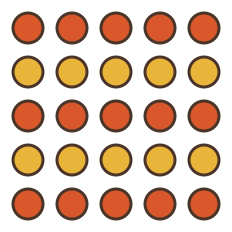
Raven pours beans onto the bench. "Twenty-five beans. Make a square."
Rocket lines them up: five rows of five. "A 5 by 5 square. So 25 is 5 squared."
"Now go backward," Raven says. "A square of 49 beans. How long is its side?"
"Seven, because 7 × 7 = 49." Rocket grins. "The square root of 49 is 7."
Nova hovers over a stack of blocks, her light on the corner. "And a cube of 27 blocks?"
"Three along, three across, three up. 3 × 3 × 3 = 27. The cube root of 27 is 3."
"What do you notice about a square of 2 beans?" Raven asks.
"No whole side works," Rocket says. "The square root of 2 is not a fraction either. It never comes out even."
Square roots
A square number is a count of beans that makes a perfect square. 25 beans make a 5 by 5 square.
The square root undoes the square. Because 5² = 25, the square root of 25 is 5, written √25 = 5.
The equation x² = 49 asks which number squared is 49. Its positive solution is x = √49 = 7.
Cube roots
A cube number is a count of blocks that makes a perfect cube. 27 blocks make a 3 by 3 by 3 cube.
The cube root undoes the cube. Because 3³ = 27, the cube root of 27 is 3, written ∛27 = 3.
The equation x³ = 64 has the solution x = ∛64 = 4, because 4 × 4 × 4 = 64.
| Side | Square (side²) | Cube (side³) |
|---|---|---|
| 1 | 1 | 1 |
| 2 | 4 | 8 |
| 3 | 9 | 27 |
| 4 | 16 | 64 |
| 5 | 25 | 125 |
| 6 | 36 | 216 |
| 10 | 100 | 1,000 |
Not every number is a perfect square. Two beans will not make a square with a whole side.
√2 is irrational: it cannot be written as a fraction of whole numbers, and its decimal never ends or repeats.
It is still a real length. A square with area 2 has a side of √2, a little more than 1.4.
- Read the question.
- Tap your answer.
These 25 beans make a square. How long is one side?- Read the question.
- Tap your answer.
- Read the question.
- Tap your answer.
| Statement | True or false? |
|---|---|
| The square root of 49 is 7. | ? |
| The square root of 64 is 8. | ? |
| The cube root of 64 is 4. | ? |
| The square root of 100 is 50. | ? |
| √2 can be written exactly as a fraction of two whole numbers. | ? |
Now try 30 beans. Can you make a square with a whole side? Write what you found.
Beans stay on the bench and away from children under three and pets. Nothing goes in a mouth.
Excellent. Tomorrow the Puzzle Lab counts a whole jar of beans without counting every bean.