Friday
Friday: Puzzle Night Plans
Rocket pins a list to the Puzzle Post wall. "Puzzle Night. Three stations. Balance, rule machine, crossing strings."
"And the bean jar," Raven adds. "Plus a square-root bag. What do you notice about the list?"
"It is the whole course," Rocket says. "Envelopes for unknowns, the machine for functions, the strings for systems."
Nova hovers over the list, her light settling on the empty space at the bottom. "Who checks the answers?"
"Everyone," Raven says. "A puzzle is finished when the answer is checked, not when it is guessed."
Rocket hangs the balance and loads two envelopes against one envelope and six beans. "Test run."
"2x = x + 6, so x is 6," Raven says. She opens the envelope. Six beans.
"Tomorrow we do that fifty times," Rocket says, "with lights on."
Huge and tiny numbers in everyday life
Steps in a year, beans in a jar, blades of grass in a yard. Big counts all fit a number times a power of ten.
Tiny measurements fit too. A sheet of paper is 1 × 10⁻² cm thick, and a drip is 3.2 × 10⁻³ cup.
Pick the unit that keeps the front number friendly, then let the exponent carry the size.
The course in six lines
- Letters stand for numbers. Expressions are equivalent when they match for every value.
- An equation is a level balance. Do the same to both sides until the letter stands alone.
- Two quantities that change together make a rule, a table and a graph. Slope is the rate of change.
- A linear equation ends one of three ways: x = a, a = a or a = b.
- Two equations at once meet at one crossing point, or never, or everywhere.
- Powers add exponents when multiplied, roots undo powers, and scientific notation shortens huge and tiny numbers.
- Read the question.
- Tap your answer.
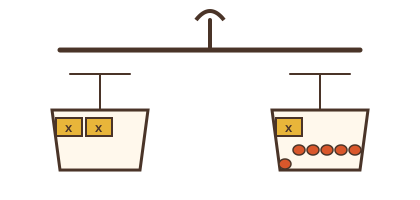 The balance shows 2x = x + 6. How many beans hide in each envelope?
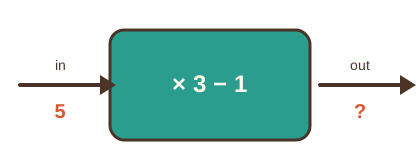 The rule is × 3 - 1. What comes out when 5 goes in?
- Read the question.
- Tap your answer.
| Statement | True or false? |
|---|---|
| 10³ × 10² = 10⁵ | ? |
| The square root of 81 is 9. | ? |
| 2,190,000 = 2.19 × 10⁶ | ? |
| 10⁻² = 0.01 | ? |
| A puzzle is finished when the answer is guessed. | ? |
- ?Choose the puzzle and work out its answer yourself.
- ?Build it: load the balance, set the machine card or lay the strings.
- ?Check your own answer against the build.
- ?Write a hint card, not an answer card.
- ?Run it for the family and let them check their answer.
Write a hint card for each. Hang the balance at chest height on a hook a grown-up has checked.
Tape the floor grid flat and keep beans away from children under three and pets.
Terrific week and a terrific course. Tomorrow night the Puzzle Post opens for the family.