Friday
Friday: Graphs That Tell a Story
Rocket pulls the pinhole plug from the full jug and lets it drain into the tray. "Watch the level."
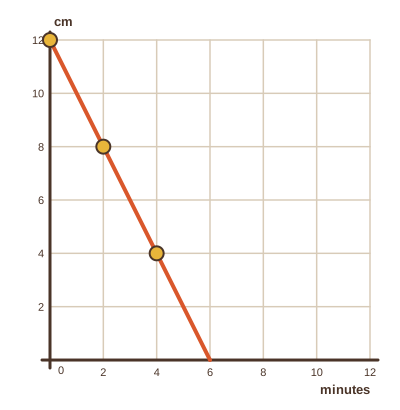
Raven marks it each minute: 12, 10, 8, 6. "What do you notice about this graph?"
"It goes down," Rocket says. "Two centimeters a minute. The rate of change is negative 2."
"And still a straight line," Raven says. "Linear, but decreasing. Height = 12 - 2 × minutes."
Nova hovers over the tray, her light on the falling water. "Describe the graph in words," she says. "Then draw one from words."
"Falling, straight, empty at 6 minutes," Rocket says.
Nova hums. "Now sketch this: a walker who speeds up, stops, then walks home." Rocket grabs a pencil.
Describing a graph in words
Read a graph from left to right. If it climbs, the function is increasing. If it falls, it is decreasing.
If it is a straight line, the function is linear and the rate of change is constant. A curve means nonlinear.
The draining jug: h = 12 - 2t. Rate of change -2, so decreasing, and linear. It reaches 0 at 6 minutes.
Sketching a graph from words
A walker speeds up: the line gets steeper. A walker who stops: the line goes flat, because distance stays the same.
A walker who comes home: the line comes back down to zero.
A sketch needs no exact numbers. Show the shape: up, flat or down, and straight or curved.
| Words | Shape of the graph |
|---|---|
| Filling at a steady rate | A straight line going up |
| Draining at a steady rate | A straight line going down |
| Stopped, nothing changing | A flat line |
| Speeding up | A curve that gets steeper |
- Read the question.
- Tap your answer.
- Read the question.
- Tap your answer.
| Week review | True or false? |
|---|---|
| A graph that falls from left to right shows a decreasing function. | ? |
| A negative rate of change means the graph goes up. | ? |
| A flat line means the quantity is not changing. | ? |
| A = s² is linear. | ? |
| The initial value is where the graph meets the vertical axis. | ? |
- ?We timed a dripping jug and wrote its rule from two marks.
- ?We compared two drip cups, one as a table and one as a rule, by rate of change and initial value.
- ?We found that the perimeter of a square is linear and its area is not.
- ?We read the card box in three forms: a story, a table and two points.
Label the three parts of your graph: increasing, flat, decreasing.
A whole week of linear functions. Tomorrow is Puzzle Day: graph stories with the family.