Monday
Monday: Beans in Rectangles
Rocket lays beans in three rows on the Puzzle Post bench. "Each row is an envelope's worth plus two more. Three rows."
"So three groups of n plus 2," says Raven. "3(n + 2). What do you notice if you look down the columns instead?"
Rocket squints. "All the envelope beans are together on the left. Three n. And the extras are together on the right. Six."
"3n + 6," Raven writes. "Same beans, two expressions."
Nova hovers above the rectangle, her light splitting it down the middle. "Two names for one number," she says. "Whatever n is."
"Puzzle three for the street," Rocket says. "Write both names, then try to find an n where they disagree."
Nova hums. "They will be trying for a long time."

The distributive property
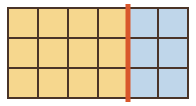
Three rows of (4 + 2) squares is 3 × (4 + 2) = 18. Count the columns instead: 3 × 4 + 3 × 2 = 18. Same squares.
With a letter it works the same way. 3(n + 2) means 3 rows of n beans and 2 more. Column by column that is 3n + 6.
This is the distributive property: multiplying a sum multiplies each part. 3(n + 2) = 3n + 6, always.
Equivalent means always
Two expressions are equivalent when they name the same number for every value of the letter.
Try n = 4. Then 3(n + 2) = 3 × 6 = 18, and 3n + 6 = 12 + 6 = 18. Try n = 10: 36 both times.
One matching value is not proof. The bean rectangle is the proof: the same beans, counted two ways, for any n at all.
- Read the question.
- Tap your answer.
A bean rectangle has 3 rows, each with 4 beans and then 2 more. How many beans in all?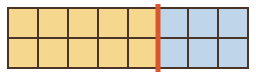 A bean rectangle has 2 rows, each with 5 beans and then 3 more. How many beans in all?
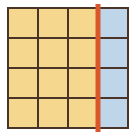 A bean rectangle has 4 rows, each with 3 beans and then 1 more. How many beans in all?
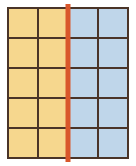 A bean rectangle has 5 rows, each with 2 beans and then 2 more. How many beans in all?
- Read the question.
- Tap your answer.
| Statement | True or false? |
|---|---|
| 3(n + 2) and 3n + 6 are equivalent. | ? |
| 3(n + 2) and 3n + 2 are equivalent. | ? |
| 2(x + 5) and 2x + 10 are equivalent. | ? |
| Two expressions are equivalent if they match for one value of the letter. | ? |
Write both expressions, 2(3 + 4) and 2 × 3 + 2 × 4, in your Puzzle Notebook.
Tape marks the split line. Press it on the bench, not on the floor where it can trip someone.
Two names for one number. Tomorrow you combine like terms and pull common factors back out.