Monday
Monday: The Envelope
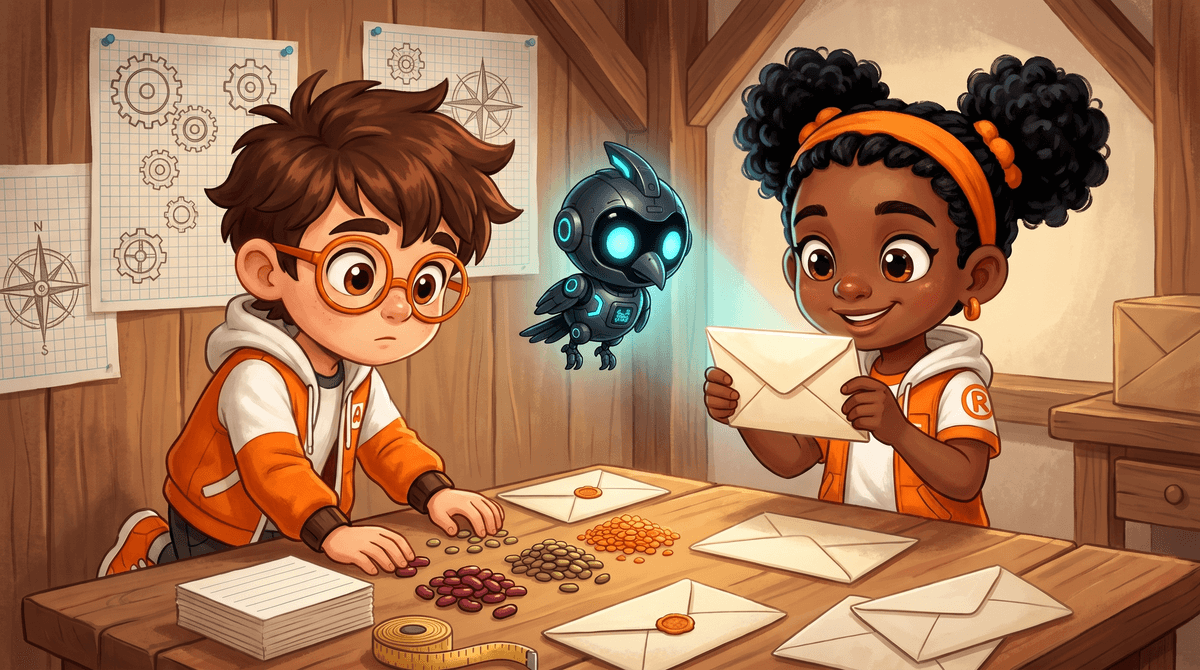
Rocket seals an envelope and sets it on the Puzzle Post bench. "There are beans in here. I will not say how many."
"Then we need a name for the number," says Raven. "Call it n. What do you notice about the beans next to it?"
Three loose beans sit beside the envelope. "So the bench holds n plus three beans," Rocket says. "Whatever n is."
Nova hovers over the envelope, her light tracing the flap. "Now say it with a letter," she says. "n + 3."
"And if I add a second envelope just like it?" Rocket asks, already reaching for one.
"Two n plus three," Raven says. "2n + 3. The letter does the hiding and the expression does the counting."
Rocket grins. "Puzzle two for the street: write what you see, then open the envelope."
A letter stands for a number
A variable is a letter that stands for a number. This week the number hides in an envelope, so we do not know it yet.
An expression with a letter still counts something. If the envelope holds n beans, then n + 3 counts the beans on the bench.
When the envelope opens and n turns out to be 8, the expression tells us: n + 3 = 11 beans.
From words to expressions
| Words | Expression | Why |
|---|---|---|
| 3 more than n | n + 3 | Adding 3 to the envelope. |
| Subtract y from 5 | 5 - y | Start at 5, take y away. The order matters. |
| Twice n | 2n | 2 × n, written without the times sign. |
| 3 more than twice n | 2n + 3 | Double first, then add 3. |
| Half of m | m ÷ 2 | Split m into two equal parts. |
In algebra the times sign is usually left out. 2n means 2 × n, and 3(n + 1) means 3 × (n + 1).
"Subtract y from 5" is 5 - y, not y - 5. Read the words slowly: what do you start with, and what do you take away?
- Read the question.
- Tap your answer.
- Read the question.
- Tap your answer.
| Statement | True or false? |
|---|---|
| 2n means 2 × n. | ? |
| "Subtract y from 5" is written y - 5. | ? |
| If n = 6, then n + 3 = 9. | ? |
| If n = 6, then 2n + 3 = 18. | ? |
Have someone open it and check the total against your expression.
Seal envelopes with the flap or tape, not with licking.
A letter is hiding a number, and you can already count with it. Tomorrow you name the parts of an expression.