Wednesday
Wednesday: Puzzle Lab: Folds and Squares
Raven tapes a chart to the garage wall: "Folds" down one side, "Layers" down the other. "Puzzle Lab. We test the doubling."
Rocket brings three sheets: a thin one, a thick one and a long paper strip. "Bet the thin one folds the most."
"What do you notice before we start?" Raven asks. "Write your guess first, then fold."
Rocket writes 10. He folds the thin sheet. One, two, three, four, five, six, and then it fights back. "Seven. Barely."
Nova hovers over the chart, scanning each row. "Seven folds," she says. "How many layers would that be? Do not count. Use the power."
"Two to the seventh," Rocket says, and starts multiplying on his fingers. Raven is already pouring beans into a square.
Your mission
Fold paper and count layers, then build bean squares and count beans. Record every count two ways: as a product and as a power.
- Three sheets of paper of different thickness, or one sheet and one long strip.
- About 40 dried beans or buttons for the squares, and a tray or a shoebox lid to keep them in.
- Your Puzzle Notebook and a marker.
- A tape measure or a ruler, to measure the thickness of the folded brick.
Fold with your hands only. No blades or scissors are needed today.
Work on a table or a taped-down mat on the floor, so nothing rolls under your feet.
- Guess how many folds each sheet will take. Write the guess down before you fold.
- Fold the first sheet in half. Write 1 fold, 2 layers, 2¹. Fold again and write the next row.
- Keep going until the sheet will not fold. Write the last row as a power of 2.
- Measure the thickness of the folded brick in millimeters and write it next to the last row.
- Build a bean square with 2 beans on a side, then 3, then 4, then 5. Count the beans in each.
- Write each bean count as a square: 2², 3², 4², 5².
The crew's fold log
| Folds | Power | Layers |
|---|---|---|
| 0 | 2⁰ | 1 |
| 1 | 2¹ | 2 |
| 2 | 2² | 4 |
| 3 | 2³ | 8 |
| 4 | 2⁴ | 16 |
| 5 | 2⁵ | 32 |
| 6 | 2⁶ | 64 |
These are the crew's own counts from the thin sheet, written in Raven's log. Zero folds is one layer, so 2⁰ = 1.
Every row doubles the one above it. By 6 folds the thin sheet had 64 layers, which is why it would not bend.
- Read the question.
- Tap your answer.
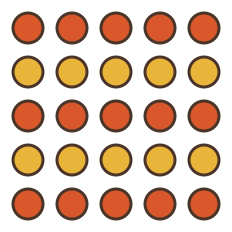
 How many beans fill a square with 3 beans on each side?
| What the lab shows | True or false? |
|---|---|
| Each fold doubles the number of layers. | ? |
| 2⁶ = 64 | ? |
| A bean square with 4 on a side holds 4 × 2 beans. | ? |
| 5² = 25 | ? |
A full lab log. Tomorrow the crew reads the card log from the first Puzzle Post round.