Monday
Monday: Fold It Again
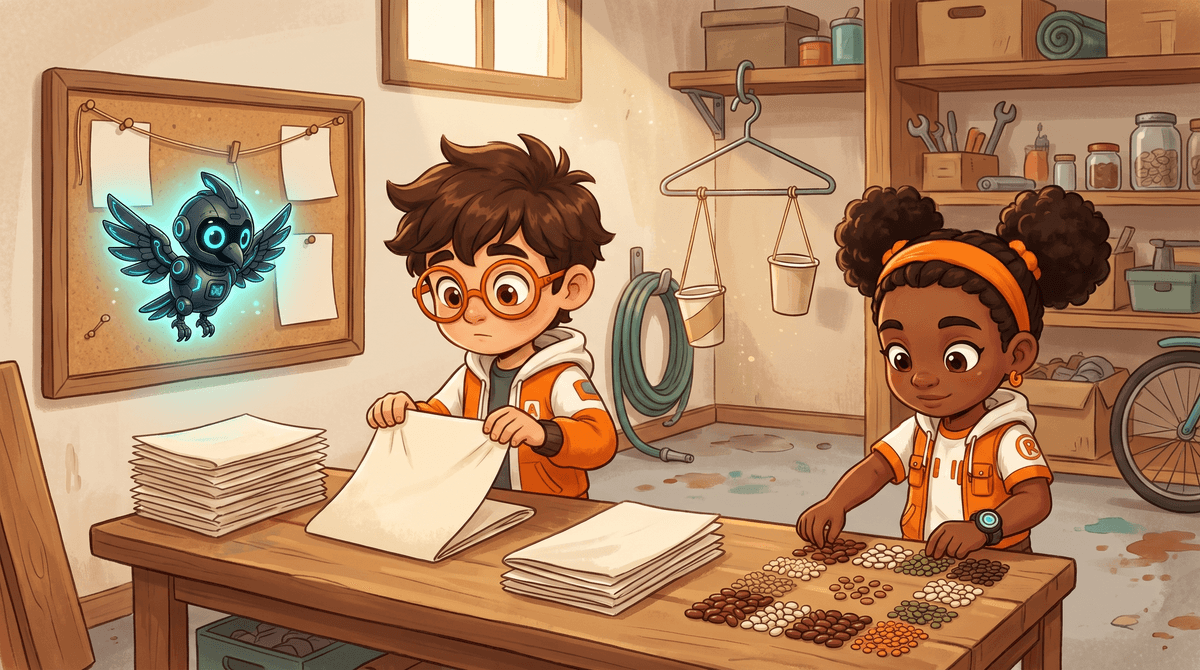
Rocket drops a sheet of paper on the Puzzle Post workbench. "Puzzle one for the street: fold this in half ten times."
"Try it," says Raven. He folds once. "Two layers." Again. "Four." Again. "Eight. This is easy."
By the sixth fold the paper is a fat little brick that will not bend. "Sixteen, thirty-two, sixty-four," Raven counts. "What do you notice about the jumps?"
"They double every time," Rocket says. "The layers are not adding up. They are multiplying."
Nova hovers over the brick, her light tracing the folded edge. "Six folds, six factors of two," she says. "There is a short way to write that."
Raven slides a bag of dried beans across the bench. "And a short way to count a square of beans," she says. "Same idea."
A power is repeated multiplication
Six folds give 2 × 2 × 2 × 2 × 2 × 2 layers. The short way to write that is 2⁶, read "2 to the sixth".
The 2 is the base, the number being multiplied. The small 6 is the exponent. It counts the factors, not the layers you add.
So 2⁶ = 64. It is not 2 × 6 = 12. That mix-up is the most common slip of the week, so watch for it.
| Folds | Multiplication | Power | Layers |
|---|---|---|---|
| 1 | 2 | 2¹ | 2 |
| 2 | 2 × 2 | 2² | 4 |
| 3 | 2 × 2 × 2 | 2³ | 8 |
| 4 | 2 × 2 × 2 × 2 | 2⁴ | 16 |
| 5 | 2 × 2 × 2 × 2 × 2 | 2⁵ | 32 |
Squares and cubes
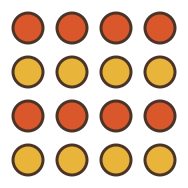
Raven's beans sit in 4 rows of 4. That is 4 × 4 = 4² = 16 beans. We say "4 squared" because the beans make a square.
Blocks stacked 3 long, 3 wide and 3 tall make 3 × 3 × 3 = 3³ = 27. We say "3 cubed" because the blocks make a cube.
Any number to the first power is itself: 7¹ = 7. One factor, nothing to multiply.
- Read the question.
- Tap your answer.
- Read the question.
- Tap your answer.
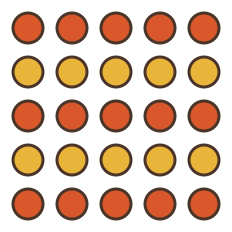 How many beans fill a square with 5 beans on each side?
| Power | True or false? |
|---|---|
| 2⁴ = 16 | ? |
| 3² = 6 | ? |
| 5² = 25 | ? |
| 2⁵ = 10 | ? |
Write each count as a power of 2 in your Puzzle Notebook.
Beans are counters, never food. They stay away from children under three and pets.
A strong start at the Puzzle Post. Tomorrow the crew agrees on one order for every step in an expression.