Monday
Monday: Define the Problem
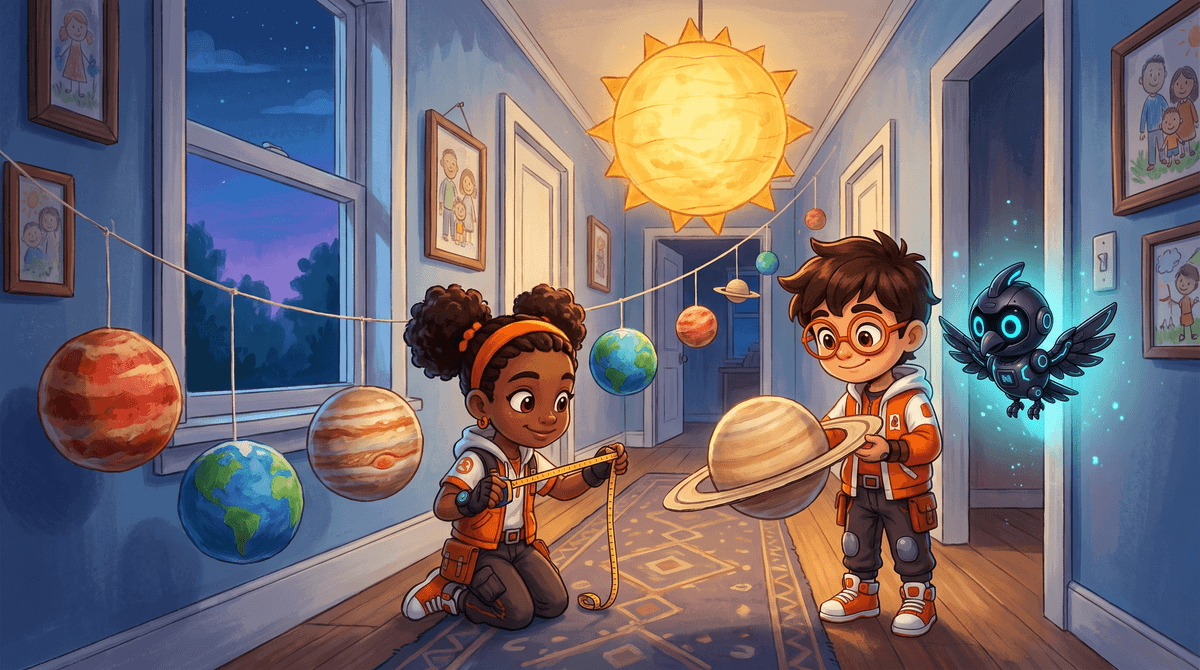
Rocket is already taping a paper Sun to the far wall of the hallway. "Solar system model. Go!"
Raven stops him with a question. "What do you notice about our hallway? It is nine meters long. Where does Neptune go?"
"The end," Rocket says. "Obviously." He pauses. "And where does Mercury go? And how big is the Sun?"
Nova hovers between them. "Engineers write down what the model must do before they build," she says. "And what limits it."
"Must do: right order, one scale, labels," Raven says, writing. "Limits: this hallway, stuff we have, one week."
Rocket lowers the tape. "Criteria and constraints first." Nova hums. "Then the fun part."
Why define first
The Next Generation Science Standards say this. The more precisely a design task's criteria and constraints are defined, the more likely the solution will succeed.
Criteria are what the design must do. Constraints are the limits it must stay inside.
The standards also say that defining constraints includes scientific principles and other knowledge that may limit possible solutions.
Your scientific knowledge this week is real NASA data: each planet's distance from the Sun and its size.
Your design problem
Design and build a scale model of the solar system that your family can walk along and understand.
Criteria: the eight planets are in the correct order, the distances follow one scale, and every marker is labeled with its name.
Constraints: it fits in your hallway or yard, it uses only household materials, and it is finished by Saturday.
One scientific limit you will meet: at a scale where Neptune fits in a hallway, the planets themselves become specks. You will decide how to handle that.
| Kind | Statement for this project | How you will check it |
|---|---|---|
| Criterion | The eight planets are in the correct order from the Sun. | compare the row of markers to the NASA table |
| Criterion | Distances follow one scale, the same for every planet. | measure each marker with a tape and compare to your plan |
| Criterion | Every marker is labeled. | count the labels: eight planets and the Sun |
| Constraint | It fits in the hallway or yard you have. | Neptune's marker is inside the space |
| Constraint | Household materials only. | list what you used |
| Constraint | Finished by Saturday. | the family tour happens on Sky Night |
- Read the question.
- Tap your answer.
| Statement | True or false? |
|---|---|
| Defining criteria and constraints precisely makes success more likely. | ? |
| Scientific knowledge can limit the possible solutions. | ? |
| Engineers should build first and define the problem later. | ? |
| A criterion is a limit on space, materials or time. | ? |
Gather possible markers: paper, string, tape, bottle caps, a ball, pencils. Use only what your family already has.
Please help clear the space and keep it away from roads. String and tape stay on the floor, never around anyone.
The data come from NASA's Planetary Fact Sheet at nssdc.gsfc.nasa.gov and from OpenStax Astronomy at openstax.org. The design steps follow the Next Generation Science Standards at nextgenscience.org.
Problem defined. Tomorrow you turn NASA's distances into a scale that fits your space.