Monday
Monday: How Old Is Earth?
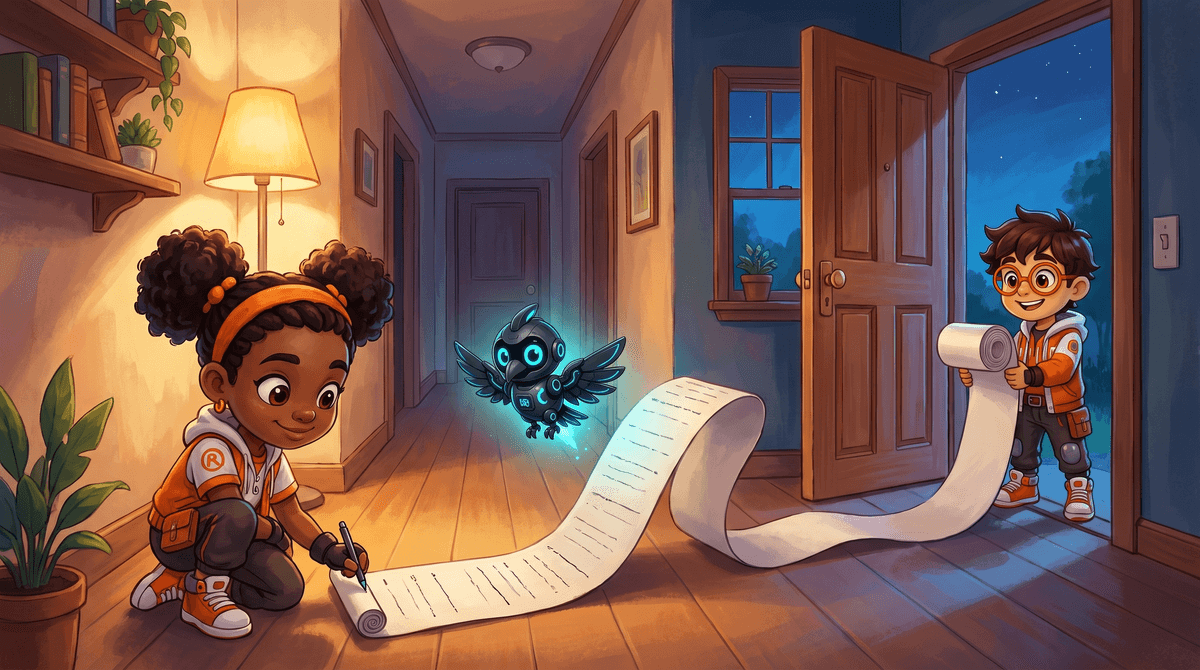
Rocket sets a new roll of paper on the Sky Deck step. "Our whole timeline," he says. "Every year of Earth."
Raven unrolls one sheet. "One sheet. How many years should it be?"
"A thousand?" Rocket tries. "A million?"
Nova hovers over the roll, her light tracing its edge. "Earth is about 4.6 billion years old," she says. "Count the sheets on the roll first."
Raven checks the wrapper and does the division in her head. "If each sheet is 100 million years, we need 46 sheets."
"That is nothing!" Rocket says. "Where does all the interesting stuff go?" Raven smiles. "What do you notice? Almost all of it is empty."
Nova hums. "That is the lesson."
A number with nine zeros
The United States Geological Survey says Earth is about 4.6 billion years old. A billion is a thousand million, so that is 4,600 million years.
The survey's best single number is 4.54 billion years, with an uncertainty of less than 1 percent.
That age does not come from one Earth rock. Earth's oldest rocks have been recycled by the rock cycle you studied in week 9.
Scientists dated meteorites, pieces of asteroids that fell to Earth. More than 70 of them formed between 4.53 and 4.58 billion years ago.
Because Earth and the other solid bodies of the solar system formed at the same time, that is Earth's age too.
The oldest things we have found
The oldest rocks found so far are the Acasta Gneisses in northwestern Canada, about 4.03 billion years old.
Single zircon crystals from Western Australia are even older, as much as 4.3 billion years. They are the oldest materials found on Earth so far.
The oldest dated Moon rocks are between 4.4 and 4.5 billion years old.
So Earth is at least 4.3 billion years old from its own materials, and about 4.6 billion from the meteorites.
| Object | Age from the survey | What it tells us |
|---|---|---|
| Meteorites (more than 70 dated) | 4.53 to 4.58 billion years | when the solar system's solid bodies formed |
| Oldest Moon rocks | 4.4 to 4.5 billion years | a minimum age for the Moon |
| Oldest zircon crystals, Western Australia | as much as 4.3 billion years | the oldest Earth material found so far |
| Oldest rocks, Acasta Gneisses, Canada | about 4.03 billion years | the oldest whole rocks found so far |
- Read the question.
- Tap your answer.
| Statement | True or false? |
|---|---|
| The survey's best age for Earth is 4.54 billion years. | ? |
| The oldest Earth material found is about 4.3 billion years old. | ? |
| Earth's very first rocks are still easy to find. | ? |
| The uncertainty in Earth's age is less than 1 percent. | ? |
Decide with a grown-up where 46 sheets can be unrolled on Wednesday: a hallway, a long room or the yard.
Please clear a hallway, a room or a yard path away from roads for the unrolling. The paper stays on the floor and is never wrapped around anyone.
The facts this week come from the United States Geological Survey at pubs.usgs.gov and the open textbook Physical Geology on geo.libretexts.org.
A big number, well sourced. Tomorrow you meet the chapters geologists use to divide it.