Monday
Monday: How Big Is Big?
Rocket sets the Earth ball on the Sky Deck table and holds up his hands, far apart. "Jupiter is this much bigger. Maybe."
"Guess a number," Raven says. "How many Earths wide?"
"Three?" Rocket says. Raven checks the NASA page. "Eleven. Jupiter is eleven times wider than Earth."
Rocket stares at the ball. "Then Jupiter would not fit on this table. And the Sun?"
Nova hovers over the ball, her light making a tiny bright dot on it. "The Sun is about 1.4 million kilometers across," she says.
"Compared to Earth's 12,756," Raven adds. "What do you notice?" Rocket whistles. "The Sun would not fit in the yard."
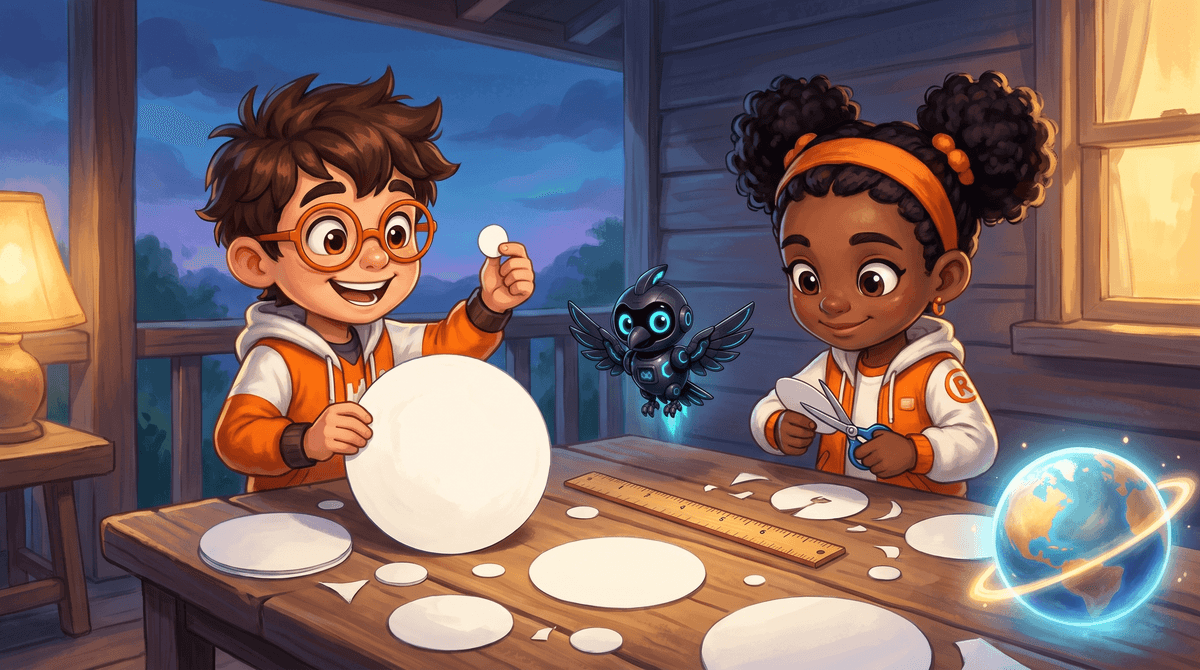
From distances to sizes
Last week you walked the distances between the planets. This week you read their sizes and other properties.
The Next Generation Science Standards ask you to analyze data to find the scale properties of objects in the solar system.
Scale properties include an object's size, its layers and its surface features. You start with size.
Diameter is the distance straight across a planet through its center. The NASA Planetary Fact Sheet lists it in kilometers.
Earth, Jupiter and the Sun
Earth's diameter is 12,756 kilometers. NASA says Earth is the biggest of the terrestrial planets and the fifth largest planet overall.
Jupiter's diameter is 142,984 kilometers. NASA says Jupiter is 11 times wider than Earth.
The Sun is the largest object in our solar system. NASA gives its diameter as about 1.4 million kilometers.
NASA adds that it would take 1.3 million Earths to fill the Sun's volume. More than 330,000 Earths would be needed to match its mass.
| Object | Diameter (km) | Compared with Earth |
|---|---|---|
| Earth | 12,756 | 1 |
| Jupiter | 142,984 | about 11 times wider |
| The Sun | about 1,400,000 | about 110 times wider |
- Read the question.
- Tap your answer.
| Statement | True or false? |
|---|---|
| Earth is the biggest of the terrestrial planets. | ? |
| Jupiter is about three times wider than Earth. | ? |
| It would take about 1.3 million Earths to fill the Sun's volume. | ? |
| The Sun is smaller than Jupiter. | ? |
Write whether Rocket's guess of three was close.
Please supervise the scissors and keep the string flat on the floor, never around anyone.
The facts this week come from the NASA Planetary Fact Sheet at nssdc.gsfc.nasa.gov, NASA at science.nasa.gov and OpenStax Astronomy at openstax.org.
Set them side by side. Write which stands for Earth and which for Jupiter.
Good start. Tomorrow the eight planets sort themselves into two families: small and rocky, or giant and gassy.