Monday
Monday: What Keeps the Planets From Flying Away?
Rocket swings a ball on a string in slow circles over the Sky Deck. "This is Earth going around the Sun," he says.
Raven watches the string. "What do you notice? If you let go, where does the ball go?"
Rocket lets go. The ball flies straight across the yard and bounces off the fence.
"Straight," Raven says. "Not in a circle. So something has to keep pulling it back toward the middle."
Nova hovers over the string lying in the grass. "In space there is no string," she says. "But there is a pull."
Rocket picks up the ball. "The Sun pulls on Earth? From all the way out there?" Nova blinks her light. "Mass is the key. Find out what mass does."
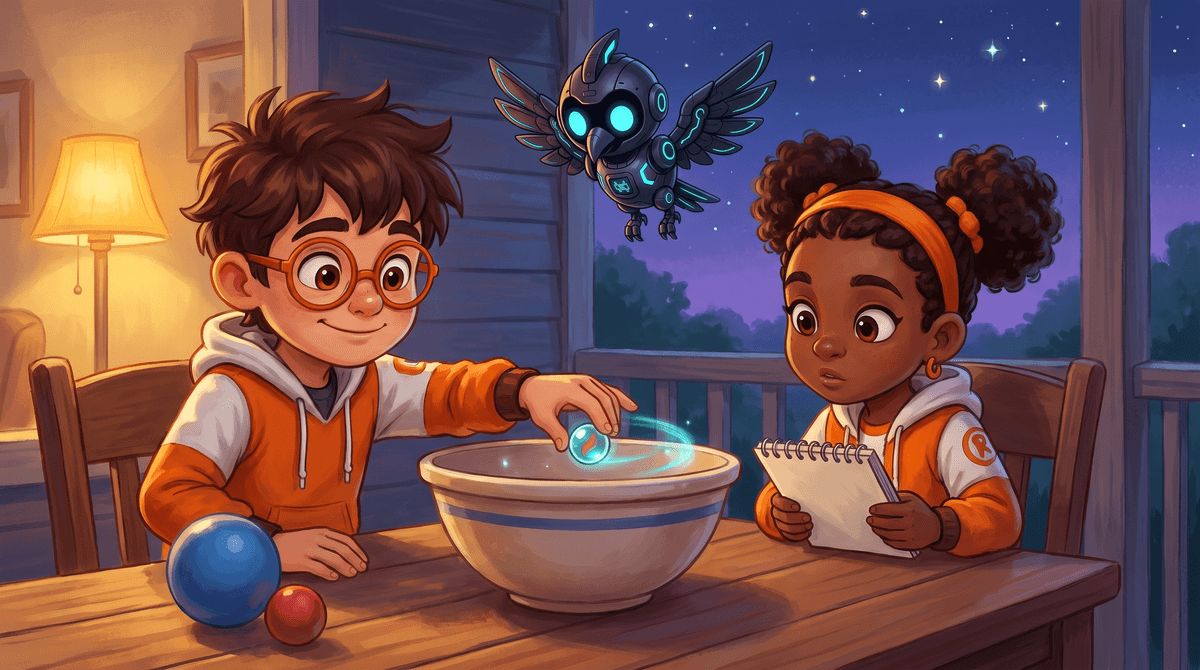
A pull with no string
Last week you modeled the seasons with a tilted Earth. This week you ask a bigger question: what holds the whole solar system together?
The Next Generation Science Standards describe the solar system as the Sun and a collection of objects. Those objects include planets, their moons and asteroids.
All of them are held in orbit around the Sun by its gravitational pull on them. No string. Just gravity.
A NASA page for students puts it simply. Gravity is the force by which a planet or other body draws objects toward its center.
Earth's gravity is what keeps you on the ground and what makes things fall. The Sun's gravity keeps Earth in orbit around it.
Two rules of gravity
Anything that has mass also has gravity. That includes you, a ball, the Moon, Earth and the Sun.
Rule one: objects with more mass have more gravity. The Sun has far more mass than Earth, so its pull is far stronger.
Rule two: gravity gets weaker with distance. The closer two objects are, the stronger their pull on each other.
Astronomers at OpenStax add a surprise. The pull never becomes zero. It gets weak, but it keeps acting no matter how far away you go.
| Change | What happens to the pull | Example |
|---|---|---|
| More mass | Stronger pull | The Sun pulls harder than Earth does |
| Less mass | Weaker pull | The Moon pulls less than Earth does |
| Closer together | Stronger pull | The Moon pulls hardest on the near side of Earth |
| Farther apart | Weaker pull | The Sun's pull is weaker at Neptune than at Mercury |
- Read the question.
- Tap your answer.
| Statement | True or false? |
|---|---|
| Anything that has mass also has gravity. | ? |
| Only stars and planets have gravity. | ? |
| Gravity gets stronger with distance. | ? |
| The Sun's pull can be felt far beyond Pluto. | ? |
Now hold the ball out to the side and let go. Does it fall toward you, or straight down? Write what you saw.
Marbles are small, so please keep them away from younger children and off the floor where someone could slip.
The facts this week come from NASA at science.nasa.gov and spaceplace.nasa.gov, from OpenStax Astronomy at openstax.org and from the NGSS at nextgenscience.org.
Write which one pulls on Earth more, and why you will never notice either pull.
Good start. Tomorrow you find out why the Moon never falls down, even though it is falling all the time.