Monday
Monday: Two Kinds of Shadow
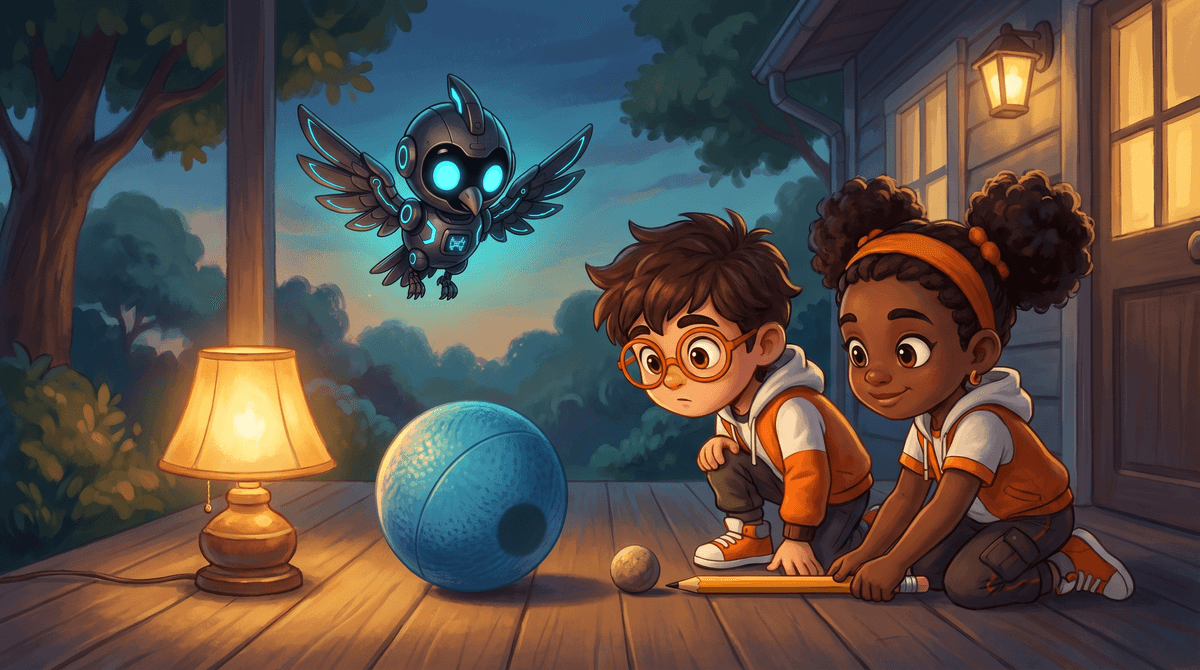
Rocket holds the orange on its pencil between his eye and the Sky Deck lamp. "It blocks the whole lamp. An eclipse."
Raven looks at the wall behind him. "What do you notice on the wall?"
"A dark spot in the middle," Rocket says, "and a fuzzy gray ring around it."
Nova hovers beside the shadow. "Two parts," she says. "Every shadow in space has them."
"So an eclipse is just a shadow landing on something," Rocket says. "Why do we not get one every month?"
Raven taps the Moon log. "The phases happen every month. Eclipses do not."
Nova hums. "The answer is a small tilt. Find it this week."
What an eclipse is
OpenStax Astronomy says any solid object in the solar system casts a shadow by blocking the light of the Sun.
In general, an eclipse occurs whenever any part of either Earth or the Moon enters the shadow of the other.
When the Moon's shadow strikes Earth, people within that shadow see the Sun at least partly covered. That is a solar eclipse.
When the Moon passes into the shadow of Earth, people on the night side see the Moon darken. That is a lunar eclipse.
NASA offers an easy way to remember: the name tells you what gets darker. Solar, the Sun. Lunar, the Moon.
Umbra and penumbra
The shadows of Earth and the Moon have two parts. The umbra is a cone where the shadow is darkest.
The penumbra is a lighter, more spread-out region of darkness around it. The most dramatic eclipses happen inside the umbra.
Which phase goes with which eclipse? NASA says solar eclipses happen only at new Moon, when the Moon is between Earth and the Sun.
Lunar eclipses happen at full Moon, when Earth is between the Moon and the Sun.
| Eclipse | Whose shadow | Falls on | Moon phase | What gets darker |
|---|---|---|---|---|
| Solar | the Moon's | Earth | new Moon | the Sun, for people in the shadow |
| Lunar | Earth's | the Moon | full Moon | the Moon, for everyone on the night side |
- Read the question.
- Tap your answer.
| Statement | True or false? |
|---|---|
| An eclipse happens when Earth or the Moon enters the shadow of the other. | ? |
| A solar eclipse happens at full Moon. | ? |
| In a lunar eclipse, the Moon gets darker. | ? |
| The penumbra is the darkest part of a shadow. | ? |
Move the ball closer to the wall and then farther away. Notice how the dark spot changes size.
The Sun is never looked at directly, with or without glasses, a camera or a phone, eclipse or not.
The facts this week come from NASA at science.nasa.gov and spaceplace.nasa.gov, and from OpenStax Astronomy at openstax.org.
Good start. Tomorrow you learn why the Moon's shadow usually misses, and why the Sun and Moon look the same size.