Monday
Monday: Why Is One Jar Pale?
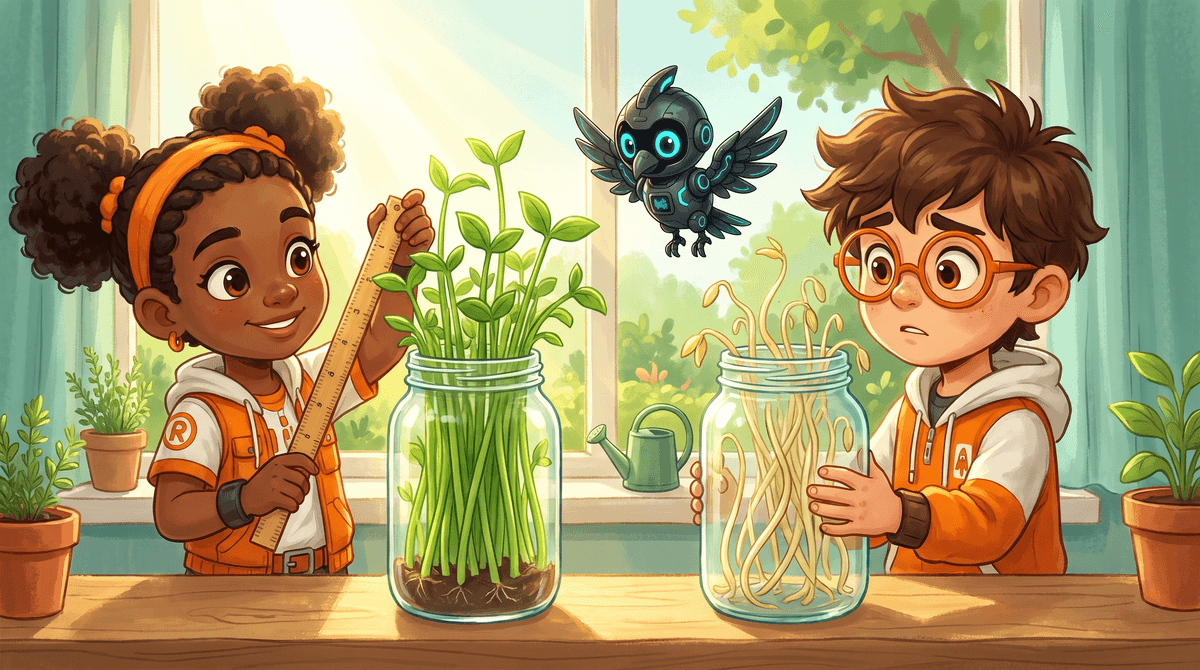
Two jars sit side by side on the Windowsill. Rocket lifts the one that spent two weeks inside a dark cupboard.
"They were the same seeds," he says. "Same water, same paper towel. Look at this one!"
The sprouts in his jar are long, thin and yellowish, leaning over the rim. The sunny jar holds short, sturdy green shoots.
Raven holds the ruler against both. "What do you notice before we measure anything?"
"Pale and floppy versus green and stiff," Rocket says. "The dark one grew taller, though. That is backward."
Nova hovers between the jars. "Same instructions inside every seed," she says. "So what was different?"
"Only the light," Rocket says slowly. "Only the environment."
Two kinds of factors
Scientists say that genetic factors as well as local conditions affect the growth of the adult plant. That sentence has two halves.
Local conditions are environmental factors. Examples include the availability of food, light, space and water.
Genetic factors are inherited. Organisms grow and develop according to specific instructions coded for by their genes.
Those instructions pass to the young when reproduction occurs. So the young grow up to show many of the same characteristics as their parents.
A bean seed grows into a bean plant, never a sunflower. That is inheritance. Whether it grows tall or pale depends on its surroundings.
| Kind of factor | Where it comes from | Examples |
|---|---|---|
| Environmental | The conditions around the organism | light, water, space, food |
| Genetic | Inherited from parents in genes | kind of seed, kind of grass, breed of cattle |
- Read the question.
- Tap your answer.
What a trait is
The National Human Genome Research Institute defines a trait as a specific characteristic of an individual.
Traits can be determined by genes, by environmental factors, or by a combination of both.
Some traits are qualities, such as eye color. Some are quantities you can measure, such as height.
Your sprouts' height and color are traits. This week you will gather evidence about what shaped them.
| Statement | True or false? |
|---|---|
| Genetic factors and local conditions both affect how a plant grows. | ? |
| A trait can be shaped by genes, by the environment, or by both. | ? |
| The amount of light is a genetic factor. | ? |
| Height is a trait that can be measured. | ? |
Write three differences you can see between the jars in your Windowsill Log.
Write one thing that is the same about them.
Sprouts, seeds and the water in the jars are lab materials. Nothing is tasted. Hands are washed after each lab.
The facts come from the National Human Genome Research Institute glossary at genome.gov and the free textbook Biology 2e.
Good noticing. Tomorrow you learn how plants sense light and why a sprout can grow tall without being strong.