Monday
Monday: What Does a Plant Eat?
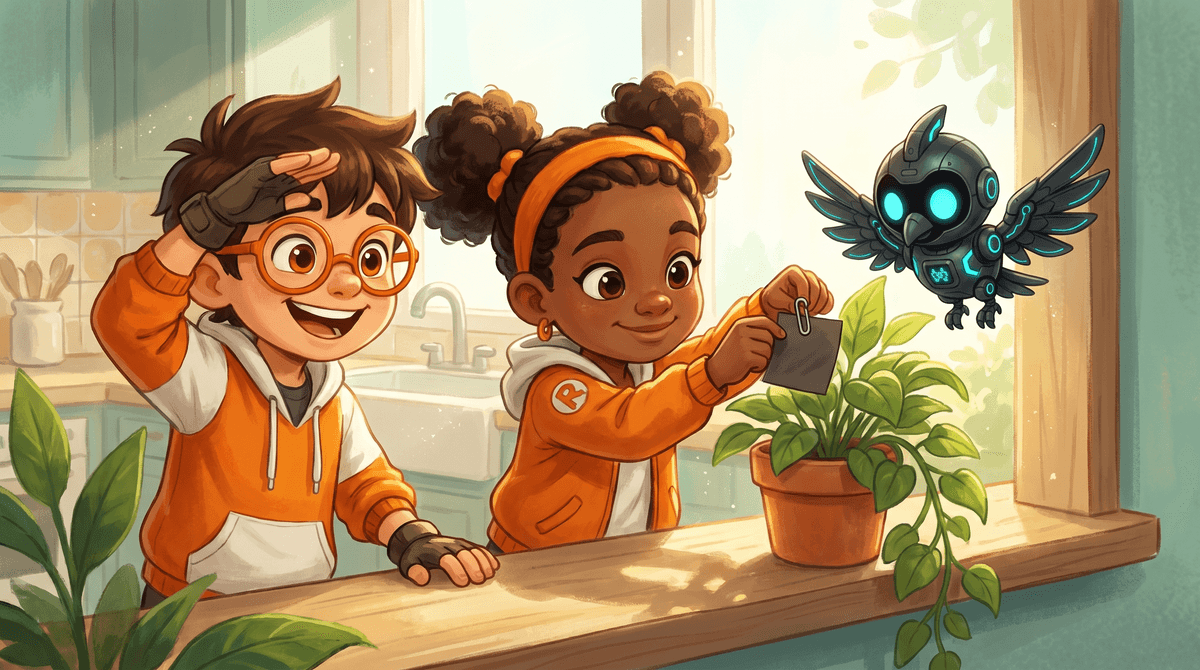
The course seedlings on the Windowsill have grown tall and lean hard toward the glass.
"They are reaching for the window," Rocket says. "Like they are hungry for it."
Raven measures the tallest one and writes the number. "What do you notice? We never fed them anything but water."
"Water is not food," Rocket says. "Where did all that green stuff come from?"
Nova hovers over the jar, her light bright and warm. "What comes through the window that does not come through the wall?" she asks.
"Light," Rocket says. "But you cannot eat light."
"A plant can do something with it that we cannot," Raven says, and underlines a new word in the Log: photosynthesis.
Self feeders and other feeders
Some organisms can carry out photosynthesis and others cannot. An autotroph is an organism that can produce its own food.
The Greek roots of autotroph mean self feeder. Plants are the best-known autotrophs, but certain bacteria and algae are autotrophs too.
Heterotrophs cannot make their own food. They must get energy and carbon by consuming other organisms. The word means other feeder.
Humans are heterotrophs, and so are all animals. Even when an animal eats another animal, the food traces back to plants.
A deer gets energy by eating plants. A wolf that eats the deer gets energy that originally came from those plants.
What goes in and what comes out
Photosynthesis requires sunlight, carbon dioxide and water as starting reactants.
After the process is complete, photosynthesis releases oxygen and produces sugar molecules, most commonly glucose.
These sugar molecules contain the energy that living things need to survive. The plant builds itself and runs itself on them.
Photosynthesis also results in the release of oxygen into the air. To eat and to breathe, humans depend almost entirely on photosynthesizers.
| Goes in | Comes out |
|---|---|
| Sunlight (energy) | Sugar, most commonly glucose (stores the energy) |
| Carbon dioxide (from the air) | Oxygen (released to the air) |
| Water |
- Read the question.
- Tap your answer.
| Statement | True or false? |
|---|---|
| Plants are autotrophs. | ? |
| Humans can carry out photosynthesis. | ? |
| Photosynthesis releases oxygen. | ? |
| A wolf's energy traces back to plants. | ? |
Mark the jar with a bit of tape so you remember which one. Check it again on Friday.
Write today's seedling heights in your Windowsill Log, as you have every week.
Only pantry beans or lentils are used, never seeds from a garden packet. Nothing is tasted. Hands are washed after each lab.
The facts come from the OpenStax textbook Concepts of Biology and NASA's Earth science pages for kids, both free online.
Good thinking. Tomorrow you will go inside a leaf to find where the light is caught.