Monday
Monday: What a Plant Cell Has Extra
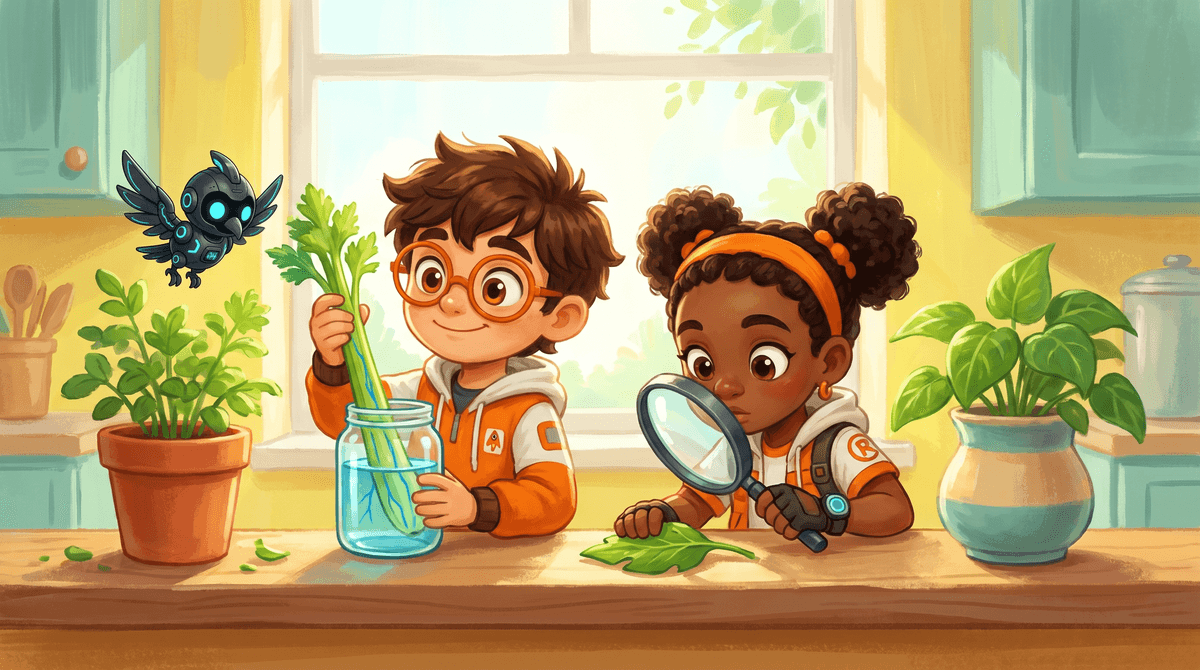
Rocket stands a celery stalk upright on the Windowsill. It stays up, stiff as a ruler. "How does it do that? No bones."
Raven bends it a little. It springs back. "What do you notice? Your bag model from last week would just flop over."
Nova hovers over the seedling in the jar, now showing its first pale green leaf. "And why is that leaf green?" she asks.
"Because plants are green," Rocket says. Raven raises an eyebrow. "That is not a reason."
"Plant cells have extra parts," Nova says. "A wall, and green parts that catch light."
Rocket picks up the celery again. "A wall around every cell. That is why it stands." Raven nods. "And the green is this week too."
Everything an animal cell has, plus more
Plant cells have a membrane, cytoplasm, a nucleus and mitochondria, just like your cells. They also have parts that animal cells do not.
An open college text, Concepts of Biology, says plant cells have a cell wall, chloroplasts and a large central vacuole. Animal cells have none of these.
The celery stalk in this week's lab is a lab material, not a snack. Nothing at the Windowsill is tasted.
The cell wall
Outside the plant cell's membrane is the cell wall. It is a rigid covering that protects the cell, provides structural support and gives the cell its shape.
The main material in a plant cell wall is cellulose, long straight chains built from sugar units. Fungal cells have cell walls too.
Because every plant cell has a wall, a stalk made of millions of walled cells can stand upright without any bones.
Chloroplasts and the color green
Chloroplasts are the parts where photosynthesis happens. In photosynthesis, carbon dioxide, water and light energy are used to make sugar and oxygen.
Chloroplasts contain a green pigment called chlorophyll, which captures the energy of sunlight. That is why leaves are green.
Plants make their own food. Animals cannot, so they must eat. This is the major difference between plants and animals.
| Cell part | In animal cells? | In plant cells? | Job |
|---|---|---|---|
| Cell membrane | yes | yes | boundary; controls what enters and leaves |
| Nucleus | yes | yes | houses DNA |
| Mitochondria | yes | yes | convert energy from food |
| Cell wall | no | yes | protection, support and shape |
| Chloroplasts | no | yes | photosynthesis; make food from light |
| Large central vacuole | no | yes | stores water; keeps the cell firm |
- Read the question.
- Tap your answer.
| Statement | True or false? |
|---|---|
| Plant cells have a nucleus and mitochondria, like animal cells. | ? |
| Animal cells have chloroplasts. | ? |
| The cell wall is outside the cell membrane. | ? |
| Plants must eat other living things for food. | ? |
Find the small dots or holes in the cut end. Count them and record the number. You will color them on Wednesday.
Check the seed jar. Measure the longest root and stem in millimeters, and note the leaf color.
Please do any cutting of the celery yourself, including trimming the base and slicing it across after the lab.
Celery is a lab material in this course and is not eaten afterward. Hands are washed after each lab.
The facts this week come from the OpenStax textbooks Concepts of Biology and Biology, free at openstax.org.
Good start. Tomorrow you learn why green is the color that bounces off, and how a plant carries water.