Monday
Monday: Is It Alive?
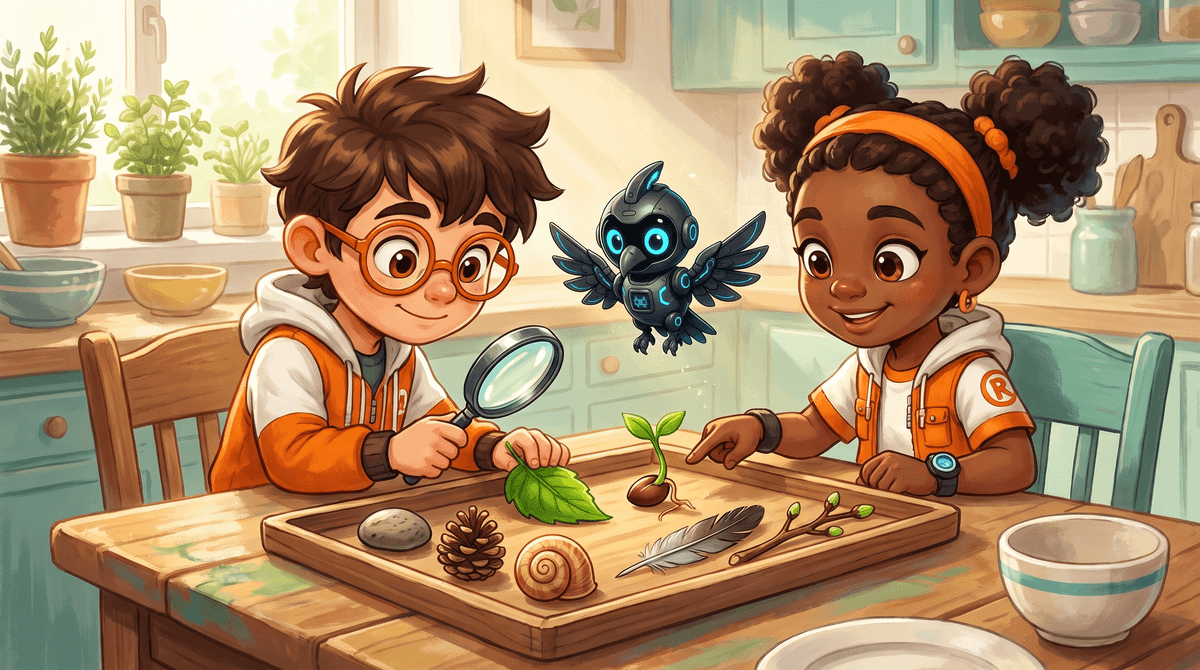
Rocket tips a tray onto the sunny kitchen windowsill. Out roll a pebble, a dried bean, a seashell, a leaf, a paper clip and a snail shell.
"Sort them," he says. "Living on the left, not living on the right. Easy."
Raven picks up the bean and the pebble. Both are hard, dry and brown. "What do you notice? These two look almost the same."
Nova hovers over the tray, her light sweeping across it. "Looks can fool you," she says. "Ask what each thing can do."
Rocket frowns. "A pebble cannot grow. Can a bean?"
"Not like this," Raven says. "But give it water and watch." Nova hums. "You have just found this week's big question."
Welcome to the Windowsill
This course happens at the Windowsill, a life-science lab on a sunny kitchen windowsill. Everything in it is something a family already has.
You will need clean glass jars or clear cups, paper towels and dried beans or lentils from the pantry. Add a ruler and a hand lens or a phone camera.
Keep a Windowsill Log. Every time a lesson says journal, write what you saw, counted, measured or changed. The log is yours and is never graded.
The dried beans and lentils in this course are lab materials, not snacks. Nothing at the Windowsill is ever tasted.
What living things do
An open college biology text, Concepts of Biology, lists characteristics that all living things share. Four of them matter most this week.
Living things are made of one or more cells. Living things use energy. Living things grow and develop. Living things respond to their surroundings and reproduce.
A pebble does none of these. A paper clip does none of these. A dried bean seems to do none of them either, which is the puzzle.
The bean is a seed. Inside is a tiny plant and a store of food, resting until water arrives. A seed can rest for months or even years.
| Object | Made of cells? | Uses energy? | Grows? | Responds? | Living? |
|---|---|---|---|---|---|
| Pebble | no | no | no | no | no |
| Paper clip | no | no | no | no | no |
| Leaf on a plant | yes | yes | yes | yes | yes |
| Dried bean seed | yes | yes, very slowly | yes, once it sprouts | yes, to water | yes |
- Read the question.
- Tap your answer.
| Statement | True or false? |
|---|---|
| All living things are made of one or more cells. | ? |
| A pebble grows a little every year. | ? |
| A dried bean is a seed with a tiny plant inside. | ? |
| Something that looks dry and still cannot be alive. | ? |
Look at one closely with a hand lens or a phone camera zoom. Find the small scar where it was attached inside its pod.
Write "seeds collected" and the date in your Windowsill Log. They get planted on Wednesday.
Please hand over only dried beans or lentils from the pantry. Seeds from a garden packet may be treated and are not used.
Seeds, yeast and celery are lab materials in this course and are never eaten. Students wash hands after every lab.
The life-science facts this week come from the OpenStax textbook Concepts of Biology, which is free to read at openstax.org.
Good sorting. Tomorrow you will meet all eight characteristics scientists use to define life, and the man who named the cell.