Monday
Monday: Animals That Stick Together
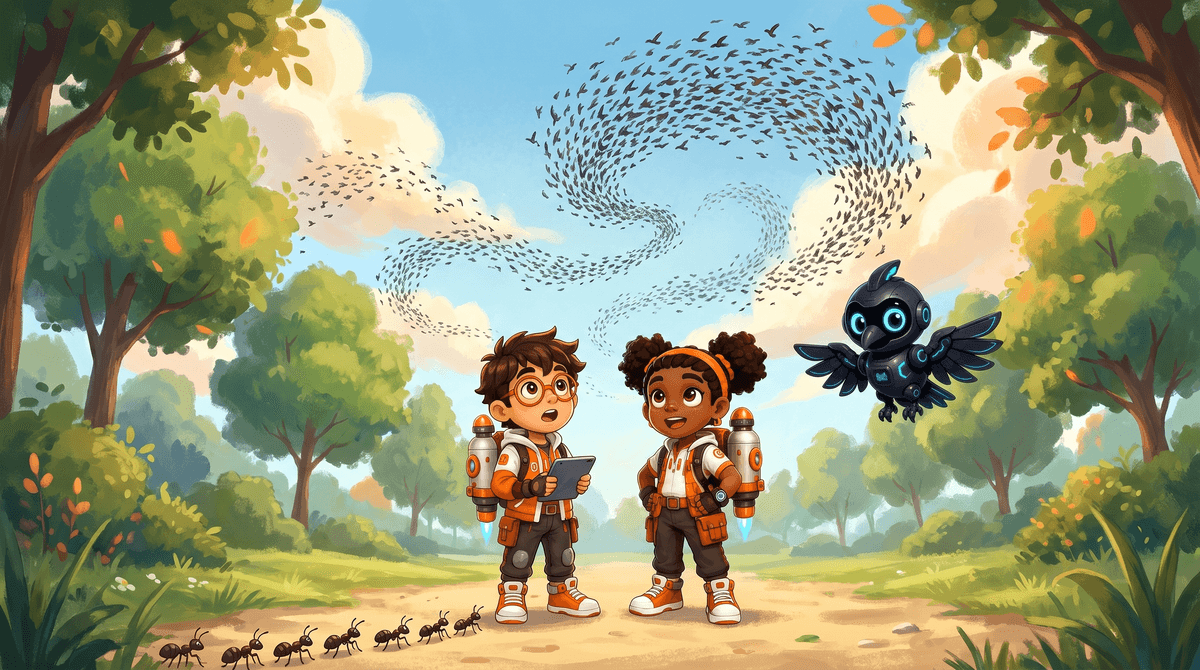
A cloud of small birds lifts off the park lawn all at once. Rocket ducks.
"Whoa! Why do they all fly together like that?"
Raven counts under her breath. "Thirty, at least. What do you notice about how they turn?"
"Like one giant bird," says Rocket.
Nova hovers beside them. "Nobody is in charge," she hints. "So how do they stay together?"
Groups have names
Some animals spend most of their lives alone. Many spiders do.
Other animals live in groups. Scientists have special names for these groups.
A group of birds is a flock. A group of large plant eaters, like deer, is a herd.
A group of fish swimming together is a school.
Ants and honeybees live in colonies. A colony shares one home and works together.
Living in a group takes effort. The animals must stay close and share space.
So why do so many animals do it? Because a group helps its members survive.
| Group name | Animals | Where you might see one |
|---|---|---|
| flock | birds | on a lawn, a wire or in the sky |
| herd | deer and other large plant eaters | the edge of a field at dusk |
| school | fish | shallow water in the creek |
| colony | ants, bees | an anthill, a hive, a hollow tree |
- Read the question.
- Tap your answer.
Three big reasons
This week you will learn three ways a group helps animals survive.
First, a group is safer. Many eyes can spot danger sooner than two.
Second, a group can find food faster and share what it finds.
Third, a group can care for young together and keep each other warm.
Not every group does all three. But every group does at least one.
- Safety: more eyes, more ears, and a crowd that is hard to single out.
- Food: more searchers find food sooner, and some groups share.
- Young and warmth: adults guard the young, and bodies huddle on cold nights.
| Statement | True or false? |
|---|---|
| Every animal lives in a group. | ? |
| A school is a group of fish. | ? |
| Living in a group can help animals survive. | ? |
| A herd is a group of birds. | ? |
Count the animals you see alone. Count the animals you see in a group.
Which number is bigger today? Write both in your notebook.
Stay with your grown-up and look with your eyes only.
Wash your hands when you come back inside.
Great counting, explorer! Tomorrow we find out how a group keeps its members safe.