Monday
Monday: Reading the Signs
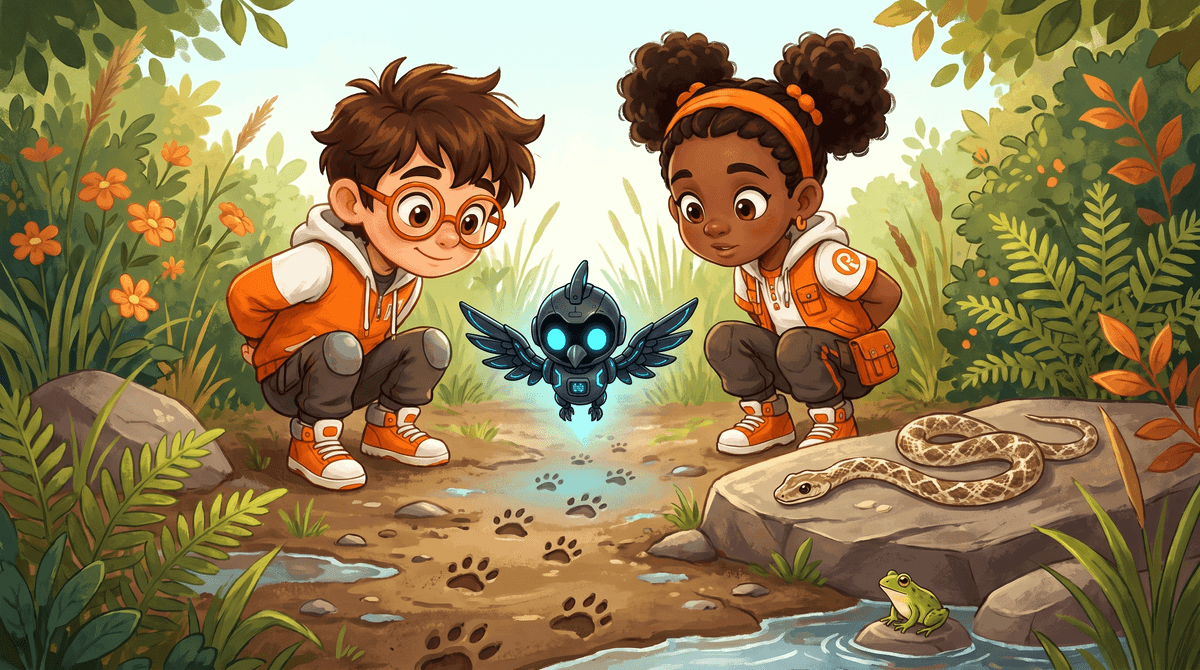
Rocket stops on the muddy creek path. "Footprints! Something walked here before us."
Raven crouches and counts the toes. "Four toes on each print. Small claw marks too."
Nova projects a cyan ruler beside the track. "Measure it," she says. "Then look around for more clues."
Rocket spots a pile of chewed shells by a log. "The animal had a snack here!"
Raven writes: two signs, one mystery animal.
Animals leave clues
Most wild animals hide from people. You may never see them.
But every animal leaves signs behind. A sign is a clue that an animal was there.
Explorers read signs the way detectives read clues.
A track is a footprint in mud, sand, dust or snow.
Scat is the scientific word for animal droppings. Scientists study it to learn what an animal ate.
Some animals shed their skin as they grow. The old skin is a sign.
Calls are signs you hear. A frog chorus at night tells you frogs live nearby.
Nibbled leaves, chewed shells, holes in the ground and tufts of fur are signs too.
| Sign | What it tells you |
|---|---|
| tracks | how big the animal was, how many toes, which way it went |
| scat | what the animal ate |
| shed skin | an animal grew and left its old covering |
| calls | which animals are nearby, even when hidden |
| nibbled leaves or chewed shells | what the animal ate and where it ate it |
| holes and burrows | where an animal may live |
- Read the question.
- Tap your answer.
Observe first, then infer
In week one you learned the difference between observing and inferring.
An observation is what you see: four toes, claw marks, a thumb-long print.
An inference is your best guess about what it means: a small mammal walked here.
Good explorers write the observation first. Then they write the inference and mark it as a guess.
A guess can be wrong. An observation written carefully is always useful.
| Statement | True or false? |
|---|---|
| Every wild animal is easy to see. | ? |
| Scat can tell scientists what an animal ate. | ? |
| A call is a sign you hear. | ? |
| Four toes in a track is an inference. | ? |
Can you find any track, even a pet or a bird? Count the toes from where you stand.
Look for one more sign nearby: a nibbled leaf, a hole, a feather.
Never touch or follow a wild animal. Watch from far away.
Stay with your grown-up. Wash your hands when you come in.
Sharp detective work! Tomorrow we meet the furry neighbors who leave many of these signs.