Monday
Monday: What Makes an Insect an Insect
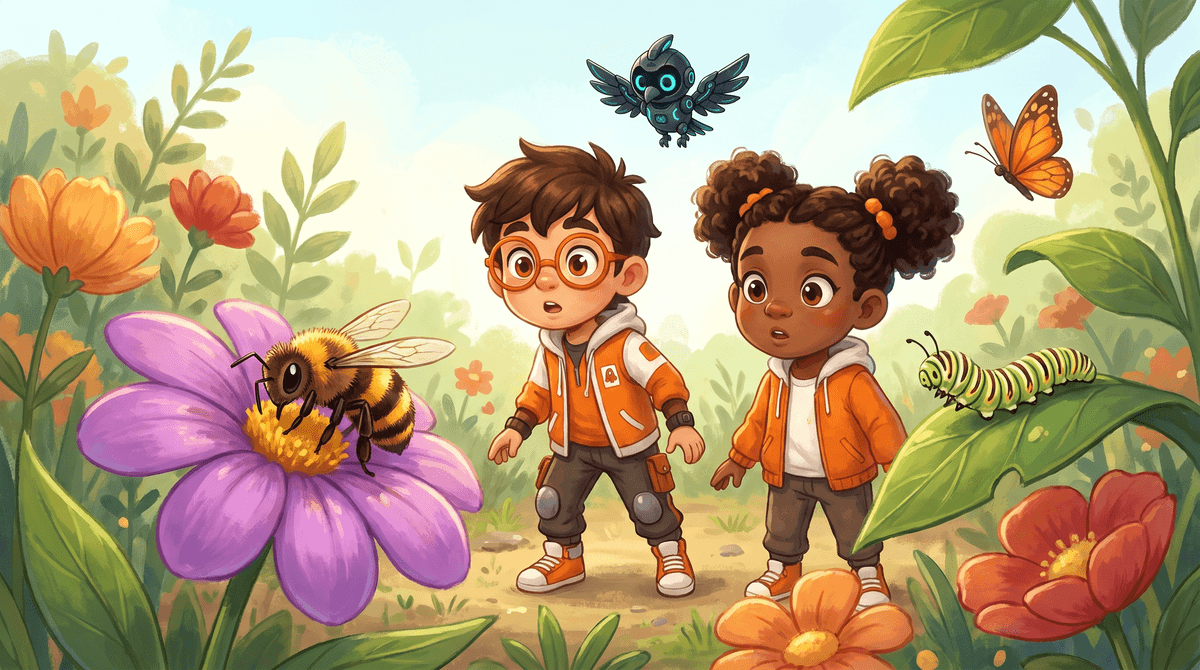
Rocket crouches by the workshop steps with his orange glasses pushed up. "A beetle! It must have a hundred legs!"
Raven kneels beside him and opens the field notebook. "Count again. Slowly."
Nova hovers low and projects a cyan outline around the beetle. "Count the legs on one side," she says. "Then double it."
Rocket counts under his breath. "Three on each side. Six legs!" Raven writes it down.
The insect body plan
Insects are the biggest group of animals on Earth.
Every insect has six legs. Every insect has three body parts.
The head holds the eyes, the mouth and two feelers called antennae.
The middle part is the thorax. The legs and wings attach there.
The back part is the abdomen. It holds the stomach and other inside parts.
An insect has no bones inside. Its hard outer covering gives it shape.
Scientists call that covering an exoskeleton. Exo means outside.
| Body part | Where it is | What attaches there |
|---|---|---|
| head | the front | eyes, mouth, antennae |
| thorax | the middle | six legs, wings |
| abdomen | the back | nothing outside, but many parts inside |
- Read the question.
- Tap your answer.
Not every bug is an insect
People say bug for any small creepy crawly thing. Scientists are more careful.
A spider has eight legs and two body parts. A spider is not an insect.
Spiders belong to a group called arachnids. Ticks and scorpions are arachnids too.
A worm has no legs at all. A worm is not an insect either.
A millipede has far too many legs to be an insect.
When you find a small animal, count its legs. Six legs means insect.
- Insects: six legs, three body parts, antennae.
- Spiders: eight legs, two body parts, no antennae.
- Worms: no legs at all.
- Most adult insects have wings. Spiders never do.
| Statement | True or false? |
|---|---|
| A spider is an insect. | ? |
| Every insect has six legs. | ? |
| Insects have bones inside their bodies. | ? |
| The abdomen is the back part of an insect. | ? |
Find one small animal. Do not touch it. Count its legs from where you stand.
Say out loud: insect or not an insect? Tell your grown-up why.
Some insects sting and some bite. Stay calm and step back if one comes close.
Stay with your grown-up outside. Wash your hands when you come in.
Great counting, explorer! Tomorrow we follow an insect from egg to adult.