Monday
Monday: Observation or Inference?
Rocket bursts out of the workshop door. "A giant bird nested in our tree! I know it!"
Raven looks up. "What do you actually see?" she asks.
Rocket squints. "Um. A pile of sticks on a branch."
Nova hovers beside Rocket. "That is one thing you saw," she says. "The giant bird is a different thing. Can you tell which is which?"
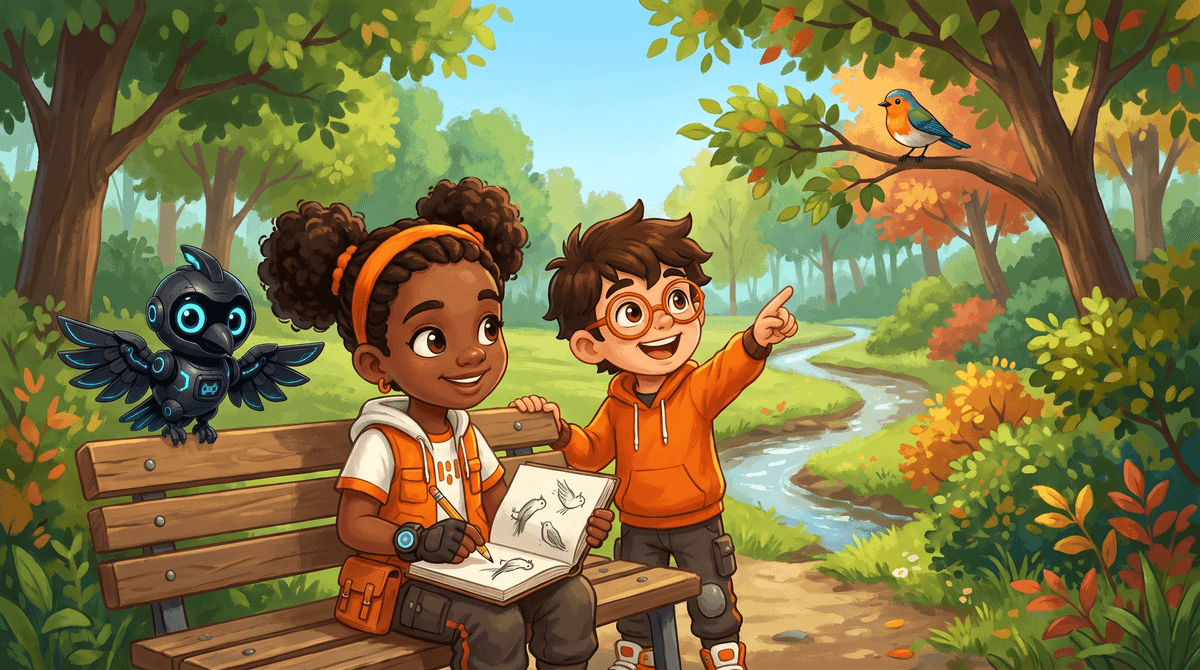
Two kinds of thinking
A naturalist is a person who studies living things outdoors.
Naturalists use two kinds of thinking. The first is observation.
An observation is something you notice with your senses. You see it, hear it, smell it or feel it.
"A pile of sticks is on the branch" is an observation. Anyone standing there could check it.
The second kind of thinking is inference.
An inference is a guess that explains what you observed.
"A bird built it" is an inference. It might be right. It might be wrong.
Both kinds of thinking matter. The trick is to know which one you are doing.
| What Rocket said | Observation or inference? | Why |
|---|---|---|
| A pile of sticks is on the branch. | observation | He saw it with his eyes. |
| A giant bird built it. | inference | It is his guess about the sticks. |
| The leaves near it are brown. | observation | He can see the color. |
| The tree is sick. | inference | It is a guess that explains the brown leaves. |
- Read the question.
- Tap your answer.
Why the difference matters
Your senses collect information. Your brain turns that information into ideas.
When you mix the two up, you can fool yourself.
Rocket skipped the sticks and jumped straight to a giant bird.
A careful naturalist writes the observation first. The inference goes next, marked as a guess.
Later, more observations can show if the guess was right.
| Statement | True or false? |
|---|---|
| An observation uses your senses. | ? |
| An inference is always right. | ? |
| "The flower is yellow" is an observation. | ? |
| "The flower is yellow to attract bees" is an observation. | ? |
Say three observations out loud. Start each one with "I see" or "I hear".
Then make one inference. Start it with "I think".
Sharp thinking, naturalist! Tomorrow you pick a sit spot of your own.