Tuesday
Tuesday: Move the Graph
Wren draws y = x² on the chalkboard wall, a clean parabola with its bottom at the origin.
"Now draw y = x² + 3," Comet says, and does. "Same shape, lifted three squares. What can we make of that?"
"A rule for moving graphs," Wren says. "Try y = (x - 2)². Which way does it go?"
"Left, I think," Comet says, then plots a point. "No. Right. The bottom is at x = 2 now."
Nova glows a hint. "Would you like a hint? Ask which x makes the inside zero."
"x - 2 is zero at x = 2," Comet says. "So the graph slides to where the inside is zero. Right."
"And 2x² is steeper, and -x² is upside down," Wren says. "Four moves, one table."
The four moves
| New rule | What it does to the graph of f | Example at x = 3 |
|---|---|---|
| f(x) + k | slides up k (down if k is negative) | x² + 3 gives 12 |
| f(x + k) | slides left k (right if k is negative) | (x + 1)² gives 16 |
| k f(x) | stretches taller by k (squashes if k is under 1) | 2x² gives 18 |
| -f(x) | flips over the x-axis | -x² gives -9 |
The inside move is the surprising one. The rule f(x - 2) slides right, not left. Its inside is zero at x = 2.
Comet's test: ask which x makes the inside zero. That is where the graph's special point lands.
Two ways to read a move
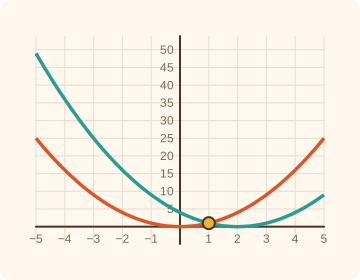
Way one, by rule: write g(x) in terms of f and read the move from the table above.
Way two, by table: plug in three x-values for f and for g, and watch how the outputs changed.
The crew does both. The rule is fast, and the table catches a left-right mix-up.
| x | f(x) = x² | f(x) + 3 | f(x - 2) | 2f(x) | -f(x) |
|---|---|---|---|---|---|
| 0 | 0 | 3 | 4 | 0 | 0 |
| 1 | 1 | 4 | 1 | 2 | -1 |
| 2 | 4 | 7 | 0 | 8 | -4 |
| 3 | 9 | 12 | 1 | 18 | -9 |
Even and odd
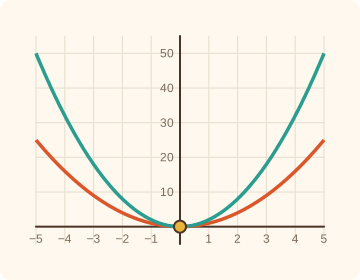
A graph that is its own mirror across the y-axis belongs to an even function: f(-x) = f(x). The parabola x² is even.
A graph that looks the same after a half turn about the origin belongs to an odd function: f(-x) = -f(x). The curve x³ is odd.
Check: (-3)² = 9 and 3² = 9. But (-3)³ = -27 while 3³ = 27.
- Read the question.
- Tap your answer.
- Read the question.
- Tap your answer.
- ?Slide it up 3
- ?Slide it right 1, because x - 1 is zero at x = 1
- ?Start with the parabola y = x² with its bottom at the origin
- ?Stretch it taller by 2
- ?Check one point: g(1) = 3 at the bottom
| Statement | True or false? |
|---|---|
| y = f(x) + 2 is the graph of f slid up 2. | ? |
| y = f(x + 2) is the graph of f slid right 2. | ? |
| (5 - 2) × (5 - 2) = 9 | ? |
| y = -f(x) flips the graph over the x-axis. | ? |
| x³ is an even function. | ? |
Sharp eyes on the moves. Tomorrow the jug fills up in the Glass House Lab and you measure how fast.