Thursday
Thursday: Where Two Graphs Meet
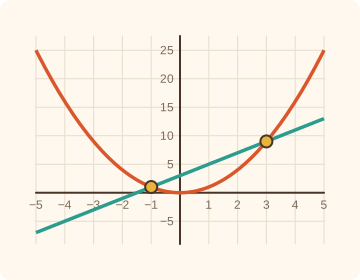
Wren draws y = x² and the line y = 2x + 3 on the wall. They cross twice.
"The crossings are at x = -1 and x = 3," he says, pointing. "What do you notice about the two rules there?"
"They give the same y," Comet says. "At x = 3, both are 9."
"So a crossing is a solution of x² = 2x + 3," Wren says. "The picture and the equation agree."
Nova projects a table beside the graph. "Would you like a hint? When the graph is fuzzy, a table can close in."
"Close in?" Comet asks. "Try x = 2, then 2.5, then 2.6, and watch which side is bigger," Wren says.
"Three ways to the same point," Comet says. "Graph, table, algebra. Today we use all three."
Why a crossing is a solution
Two graphs are y = f(x) and y = g(x). At a crossing, the point is on both graphs.
So its y equals f(x) and also equals g(x). That x makes f(x) = g(x) true: it is a solution.
- A point (a, b) lies on the graph of y = f(x) exactly when b = f(a).
- The same point lies on the graph of y = g(x) exactly when b = g(a).
- A crossing point lies on both graphs, so b = f(a) and b = g(a).
- Two things equal to b are equal to each other: f(a) = g(a).
- So a, the x-coordinate of the crossing, is a solution of f(x) = g(x).
- The steps reverse too: any solution a gives a point (a, f(a)) on both graphs.
Way one: algebra
- Set the rules equal: x² = 2x + 3.
- Move everything to one side: x² - 2x + 3 = 0, which is x² - 2x - 3 = 0.
- Factor: (x - 3)(x + 1) = 0.
- So x = -1 or x = 3. Put each back into either rule for its y.
Way two: a table that closes in
When the crossing is not a whole number, a table brackets it. Here is x² = x + 4 between x = 2 and x = 3.
| x | x² | x + 4 | difference |
|---|---|---|---|
| 2 | 4 | 6 | -2 |
| 2.5 | 6.25 | 6.5 | -0.25 |
| 2.6 | 6.76 | 6.6 | 0.16 |
| 3 | 9 | 7 | 2 |
The difference changes sign between 2.5 and 2.6, so a crossing lies there. Narrow the steps to get closer.
This is how a calculator finds a crossing it cannot factor: smaller and smaller steps until the difference is tiny.
A line meets a parabola
Any line and parabola meet twice, once or never. Set the rules equal and read the discriminant from week 1.
Take y = x² - 4x + 7 and y = x + 3. Setting the rules equal gives x² - 5x + 4 = 0.
That factors as (x - 1)(x - 4) = 0, so x = 1 or x = 4.
- ?A point (a, b) is on y = f(x) exactly when b = f(a)
- ?The same point is on y = g(x) exactly when b = g(a)
- ?So the x-coordinate a solves f(x) = g(x)
- ?A crossing is on both graphs, so b = f(a) and b = g(a)
- ?Two things equal to b are equal: f(a) = g(a)
- Read the question.
- Tap your answer.
| Statement | True or false? |
|---|---|
| At a crossing, f(x) and g(x) have the same value. | ? |
| 3 × 3 = 2 × 3 + 3 | ? |
| 2 × 2 = 2 × 2 + 3 | ? |
| A line and a parabola always meet exactly twice. | ? |
| A table of values can bracket a crossing between two x-values. | ? |
Clear reasoning. Tomorrow two functions given in different ways are compared head to head.