Thursday
Thursday: Which Rules Run Backwards?
"Every rule has an inverse, right?" Comet asks, chalk in hand.
Wren shakes his head and writes y = x² on the wall. "Run it backwards from 9. What do you notice?"
"Three. Or negative three. Two answers from one input." Comet frowns. "That is not a function."
"Two inputs shared the output 9," Wren says. "So the backwards rule cannot decide. No inverse function."
Nova projects the parabola and dims its left half. "Would you like a hint? Keep only inputs that are 0 or more."
"Then every output comes from one input," Comet says. "And the inverse is the square root. y = √x."
"A one-to-one function has an inverse," Wren says. "Cubing is one-to-one everywhere. Its inverse is the cube root."
"So the root graphs are the squaring and cubing graphs, flipped over y = x," Comet says. "Let me draw them."
When a function has an inverse
A function pairs each input with one output. Its inverse must pair each output back with one input.
That works only when no two inputs share an output. Such a function is called one-to-one.
Test a table: if an output appears twice, there is no inverse function. Test a graph: no horizontal line may cross it twice.
y = x² fails the test, because 3 and -3 both give 9. Keep only x ≥ 0 and it passes, with inverse y = √x.
The root graphs
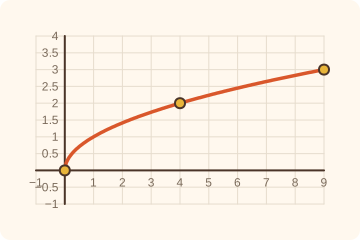
y = √x starts at the origin and rises, slower and slower. Nothing is drawn left of 0, because a negative number has no real square root.
It is the right half of y = x² reflected across the line y = x. Where the parabola has (3, 9), the root has (9, 3).
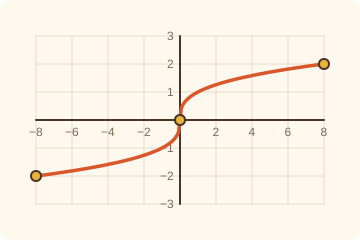
y = ∛x runs through every x, negative and positive, because every number has one real cube root. It is y = x³ reflected across y = x.
Both root graphs are one-to-one, so each has an inverse of its own: squaring (for x ≥ 0) and cubing.
Finding an inverse rule
- Write the rule as y = an expression in x.
- Swap x and y. Now the old output is the input.
- Solve for y. Undo the steps of the rule in reverse order.
- Write the result as f⁻¹(x). Check: f(f⁻¹(x)) should give x back.
For f(x) = 2x - 6: swap to x = 2y - 6, add 6, divide by 2. So f⁻¹(x) = 0.5x + 3. Check: f(0.5(8) + 3) = f(7) = 8.
Why squaring both sides can create a solution
- Start with an equation A = B, true only for the values you want.
- Squaring gives A² = B². This is true whenever A = B, but also whenever A = -B.
- So the squared equation keeps every old solution and may add solutions of A = -B.
- For our equation, x = 1 solves A = -B instead. Check: √4 = 2, and -(1 - 3) = 2.
- The check against the original equation is what removes the solutions of A = -B.
- Read the question.
- Tap your answer.
- Read the question.
- Tap your answer.
- ?The check against the original removes x = 1 and keeps x = 6
- ?Start with √(x + 3) = x - 3, which is A = B
- ?Solve the squared equation: x = 1 or x = 6
- ?x = 1 solves A = -B, because √4 = 2 and -(1 - 3) = 2
- ?Square both sides: A² = B², true when A = B or A = -B
| Statement | True or false? |
|---|---|
| y = x² has an inverse function if you use every real number as input. | ? |
| y = x³ is one-to-one, so it has an inverse function. | ? |
| The graph of y = √x has points with negative x. | ? |
| 2 × 7 - 6 = 8 | ? |
| If f(7) = 8, then f⁻¹(8) = 7. | ? |
Do the reflected points land on y = √x? Write what you notice.
Sharp thinking. Tomorrow you use inverses and roots on everyday Glass House jobs, then review the week.