Thursday
Thursday: Equations With x on the Bottom
"The new trays want 4 percent," Comet says, reading the label. "How much water do we add to the 20-liter tank?"
Wren writes 200/(x + 20) = 4 on the wall. "A rational equation. Multiply both sides by the denominator."
"200 = 4(x + 20), so x = 30," Comet says. "Thirty liters, like Monday's table."
"Now a strange one," Wren says. "(x² - 4)/(x - 2) = 5. Cross-multiply and solve."
Comet works. "x² - 4 = 5x - 10. So x² - 5x + 6 = 0. x = 2 or x = 3."
Nova pulses over the x = 2. "Would you like a hint? Put 2 back into the original denominator."
"Two minus two. Zero. The fraction has no value there," Comet says. "So x = 2 is not a solution at all."
"Extraneous," Wren says. "The algebra made it, the equation rejects it."
Solving a rational equation
- Note every value that makes a denominator zero. Those values are not allowed.
- Multiply both sides by the denominator, or cross-multiply when there is one fraction on each side.
- Solve the polynomial equation that is left. It may be linear or quadratic.
- Check each answer in the original equation. Throw out any value from step 1.
The tank: (200)/(x + 20) = 4 becomes 200 = 4(x + 20), so x = 30. The crew adds 30 liters of water.
The strange one: (x² - 4)/(x - 2) = 5 becomes x² - 4 = 5(x - 2). Solving gives x = 2 or x = 3.
But x = 2 makes the denominator x - 2 equal to zero. It is extraneous. The only solution is x = 3.
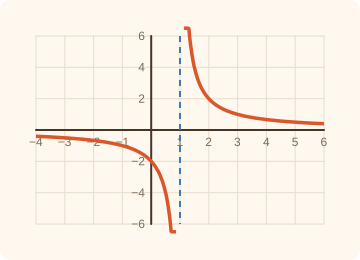
The picture shows y = 2/(x - 1). At x = 1 the denominator is zero, so the graph has no point there. An equation cannot be solved by a value its own denominator forbids.
Why an extraneous solution appears
- Start with (x² - 4)/(x - 2) = 5. The value x = 2 is not allowed, because the denominator would be zero.
- Multiply both sides by (x - 2). The new equation x² - 4 = 5(x - 2) has no denominator at all.
- Multiplying by (x - 2) multiplies both sides by 0 when x = 2. Any equation is true when both sides are 0.
- So x = 2 becomes a solution of the new equation, even though it was never a solution of the old one.
- Solving the new equation gives x = 2 and x = 3. The check sends x = 2 away, and x = 3 stays.
That is the whole story. Clearing a denominator can turn a forbidden value into a solution of the new equation. The check at the end is not optional.
- Read the question.
- Tap your answer.
- Read the question.
- Tap your answer.
- ?(x² - 4)/(x - 2) = 5, and x = 2 is not allowed
- ?Multiply both sides by (x - 2): x² - 4 = 5(x - 2)
- ?At x = 2 both sides were multiplied by 0, so both sides are 0
- ?x = 2 solves the new equation but not the old one
- ?Solve, check, and keep only x = 3
| Statement | True or false? |
|---|---|
| Multiplying both sides of an equation by (x - 2) can add a solution at x = 2. | ? |
| (3 × 3 - 4) ÷ (3 - 2) = 5 | ? |
| x = 2 is a solution of (x² - 4)/(x - 2) = 5. | ? |
| 200 ÷ (30 + 20) = 4 | ? |
| A rational equation can have no solution at all. | ? |
Did the equation have a solution? Write one sentence explaining what happened.
Sharp thinking. Tomorrow you write rational equations from Glass House jobs: mixing, and two people filling one tank.