Thursday
Thursday: Proof Day, When the Remainder Is Zero
Wren writes p(x) = x³ - 7x + 6 on the chalkboard. "Yesterday's card. Which values gave zero?"
"p(1) = 0 and p(2) = 0," Comet says. "p(3) was 12, not zero."
"So dividing by x - 1 leaves zero," Wren says. "What do you notice about x - 1?"
"It is a factor." Comet divides and gets x² + x - 6. "Which factors again: (x + 3)(x - 2)."
"Three factors, three zeros: -3, 1, 2," Wren says. "Now, why does p(a) = 0 make x - a a factor?"
Nova projects p(x) = (x - a)q(x) + r. "Would you like a hint? You proved half on Tuesday."
"If r is 0, p(x) is (x - a) times q(x). That is what a factor means," Comet says.
"And if x - a is a factor, p(a) is 0 times something," Wren says. "Both directions. A theorem."
The derivation, read first
The factor theorem has two directions. Read both, then put the steps in order below.
- Divide p(x) by x - a. The result can always be written p(x) = (x - a)q(x) + r, with r a number.
- Put x = a into both sides. The factor x - a becomes 0, so p(a) = 0 × q(a) + r = r.
- This is the remainder theorem: the remainder r equals p(a).
- Suppose p(a) = 0. Then r = 0 and p(x) = (x - a)q(x). So x - a is a factor.
- Now suppose x - a is a factor, so p(x) = (x - a)q(x). Put x = a: p(a) = 0 × q(a) = 0.
- So p(a) = 0 exactly when x - a is a factor of p(x). That is the factor theorem.
Every step uses one fact: a number times 0 is 0. The algebra just puts x = a in the right place.
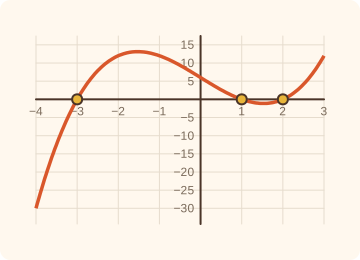
For p(x) = x³ - 7x + 6: p(1) = 0, so x - 1 is a factor. Dividing gives x² + x - 6, which factors as (x - 2)(x + 3).
So p(x) = (x - 1)(x - 2)(x + 3), with zeros -3, 1, 2. Last week's sketch starts from these.
- ?Put x = a: the factor x - a becomes 0, so p(a) = r
- ?Therefore p(a) = 0 exactly when x - a is a factor
- ?If p(a) = 0, then r = 0, so p(x) = (x - a)q(x) and x - a is a factor
- ?If x - a is a factor, then p(x) = (x - a)q(x), so p(a) = 0 × q(a) = 0
- ?Write the division as p(x) = (x - a)q(x) + r, with r a number
Factor a cubic with the theorem
- Try small whole numbers in p(x), starting with the divisors of the constant term.
- When p(a) = 0, divide by x - a. The quotient has degree one less.
- Factor the quotient, by the theorem again or as a quadratic.
- Write p(x) as a product of its factors and read off the zeros.
- Read the question.
- Tap your answer.
- Read the question.
- Tap your answer.
| Statement | True or false? |
|---|---|
| If p(a) = 0, then x - a is a factor of p(x). | ? |
| If x - a is a factor of p(x), then p(a) could be any number. | ? |
| 1 - 7 + 6 = 0 | ? |
| 27 - 21 + 6 = 12 | ? |
| p(x) = x³ - 7x + 6 has x - 3 as a factor. | ? |
Divide out one factor you find, then factor the quotient. Compare with last week's sketch of this polynomial.
Clear reasoning. Tomorrow you meet the identities: patterns that let you rewrite an expression at a glance.